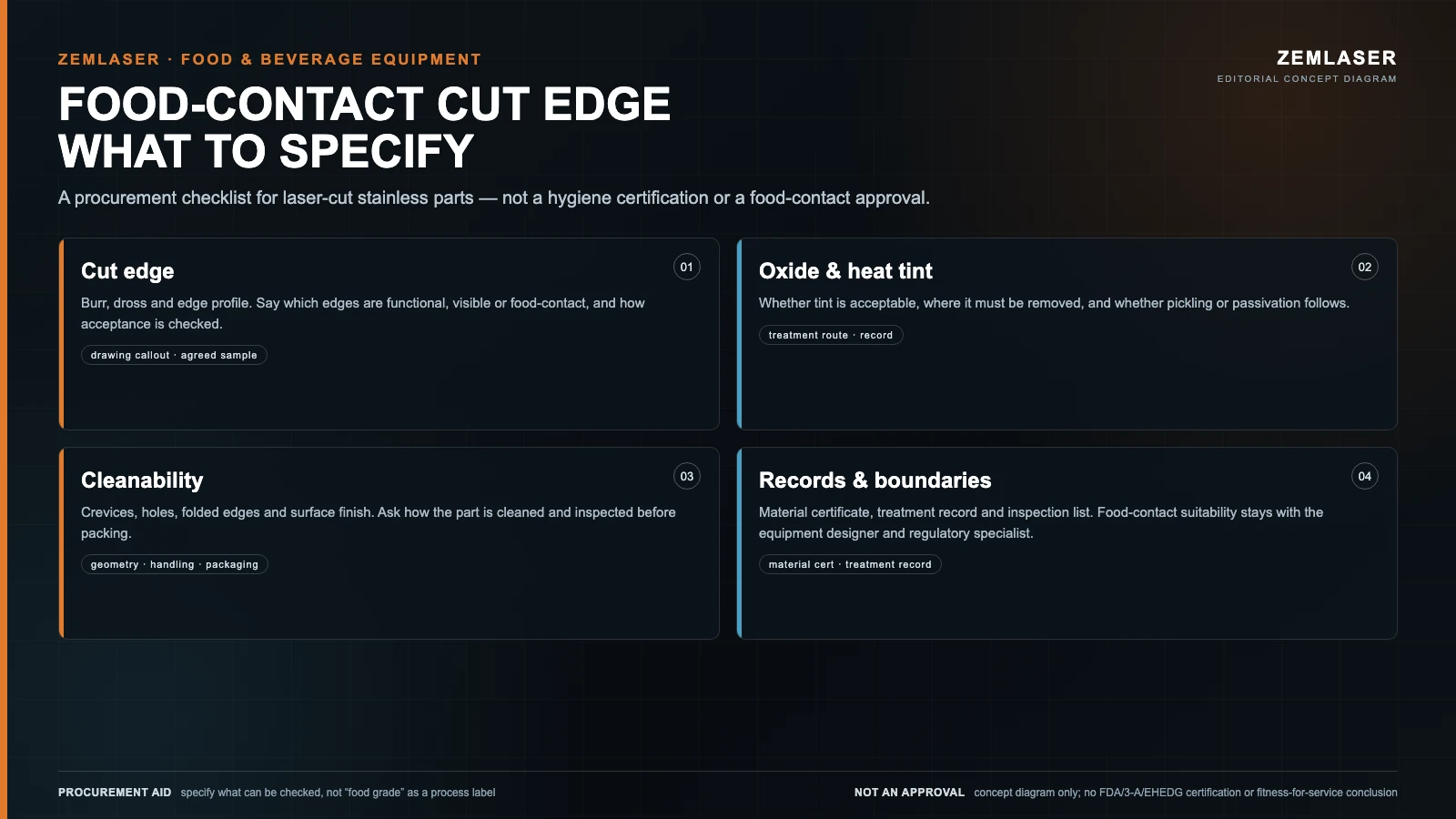
For laser-cut stainless parts on food and beverage equipment, the cut outline is rarely the deciding issue. What decides acceptability is the cut-edge burr and dross, oxide or heat tint, surface finish, and whether the geometry can be cleaned and inspected. Those conditions belong on the drawing and in the inspection agreement; “food grade metal fabrication” is not a certificate the cutting process issues.
This guide is for buyers and designers specifying laser-cut stainless parts for food and beverage equipment, or comparing suppliers against the same requirements. It covers the questions to resolve before quotation and acceptance, and it does not certify a part, a surface or a fabricator. The existing food and beverage fabrication page shows the kind of work this article supports; the requirements below remain project-specific.
The phrase is market shorthand. Regulators assess the material or article and its intended use, not the cutting method. In the U.S., the FDA defines a food contact substance as a substance that comes into contact with food and is not intended to have a technical effect in the food, including processing equipment and food preparation surfaces; a food contact substance that is a food additive must be authorized for that use before marketing.[1]
In the EU, food contact materials include machinery used to process food, must comply with Regulation (EC) No 1935/2004 when placed on the market, and must be made under Good Manufacturing Practice per Commission Regulation (EC) No 2023/2006.[2]
The FDA also notes that a material’s overall regulatory status is dictated by each individual substance that comprises the article, and that a buyer may ask the manufacturer for a letter of guaranty certifying acceptability for the intended food-contact use.[3] A laser-cut part is not “certified” by being cut on a laser. The questions to resolve are the alloy and its condition, which surfaces contact food, the food and cleaning regime, the required surface and edge condition, the target market, and the documentation the buyer needs.
For the RFQ, mark each surface as food contact, splash/indirect contact or non-contact, and state the intended use conditions. Then ask which required statements the fabricator can support with records, and which stay with the buyer or equipment designer. A blanket request for “food grade” invites an answer that cannot be verified.
A thermal cut edge can carry a burr, dross and an oxide layer, depending on material, thickness, assist gas and parameters. TWI describes dross and oxide formation as known problems in conventional low-pressure oxygen-assisted laser cutting of stainless steel, and notes that high-pressure gas with a suitable nozzle can produce clean, dross-free edges in 3 mm stainless.[4] Decide the required edge condition before quotation, not after the first parts reach the bench.
“Deburr all edges” is not an acceptance requirement. A useful edge specification states what is acceptable, where, and how it will be checked. If the part will be handled, welded or polished, the edge condition may differ by face. The existing guide to laser-cut edge finishing and deburring covers the finishing options; the RFQ still has to choose one and define its acceptance.
| Condition | What the drawing or RFQ can define | Question to resolve | Evidence to agree |
|---|---|---|---|
| Burr | Acceptance limit or a reference sample; edges where burr is not permitted; deburring method if required | How is the limit measured, on which faces, and on what sample size? | Agreed method, reference sample or first-article record |
| Dross | Whether dross is acceptable on non-functional edges; which edges are functional or visible | Does the part need a secondary removal operation, and who owns it? | Visual acceptance on an agreed sample, plus the operation included in the scope |
| Oxide and heat tint | Whether tint is acceptable; which surfaces must be free of it; treatment to follow | Is removal mechanical, chemical or both, and is passivation needed after? | Treatment record, visual reference or test method agreed with the buyer |
| Cut-face texture | Functional or cosmetic requirement, if any; reference surface or sample | Is the requirement functional (sealing, cleaning) or only visual? | Reference sample or agreed measurement method |
| Edge geometry | Radius, chamfer or break requirement for product-contact or handling edges | Is a sharp edge a safety issue, a cleaning issue or both? | Drawing callout plus first-article check |
| Surface contamination | Freedom from oil, adhesive residue, markings and foreign metal particles | What cleaning state is required before packing, and who confirms it? | Agreed cleaning step and record; visual check on the packed part |
Keep the definitions in one place: the drawing, RFQ scope and inspection list should use the same words. If “deburred” means a hand-broken edge in the RFQ but a polished radius on the drawing, the supplier will price and inspect against the weaker reading.
Not automatically. Passivation is a treatment decision, not a default step for every laser-cut part. TWI explains that, to maintain optimum corrosion resistance after welding or improper heat treatment, oxide scale and the chromium-depleted layer must be removed; acid pickling, preferably preceded by grinding, gives the best corrosion resistance, while brushing or blasting generally does not remove the chromium-depleted layer.[5] A laser cut is a thermal process, so the same question applies to a tinted cut edge: is the tint acceptable here, and if not, which removal route is specified?
ASTM A967/A967M is a reference for the treatment itself: it covers chemical passivation treatments for stainless steel parts, including immersion in nitric or citric acid solutions and electrochemical treatment, with rinsing and tests for effectiveness.[6] Its scope also states that it makes no recommendations on the suitability of any grade, treatment or acceptance criteria for a particular application. “Passivate per ASTM A967” can define a treatment and its verification; it does not by itself make a part suitable for a given food-contact or cleaning duty.
For the RFQ, resolve where heat tint or oxide is present and whether it is acceptable there; if removal is required, which process; whether passivation follows; which tests confirm the treatment; and who keeps the process record. A supplier can propose a route, but acceptability stays with the buyer and designer, with food-safety or regulatory input where needed.
Specify the finish for the function it serves: cleanability, product contact, sealing, appearance or a downstream process such as welding. A single roughness number is easy to copy but hard to verify unless the instrument, cut-off, direction and location are also agreed. If a finish matters, add a reference surface or approved sample and say where it applies.
Two details matter more than the finish name. Does the finish apply to the cut edge as well as the face? And is it produced before or after cutting and forming, since the operations interact? The guide to stainless steel laser cutting covers how the cut edge is produced, and laser cutting tolerances covers the dimensional side; the finish specification should reference both rather than contradict them.
For brushed or grained finishes, state the direction per face. For mirror finishes, state which faces are cosmetic and how appearance will be compared. For cleanable finishes, ask how finish and edge treatment are checked, and keep decorative requirements separate from hygiene-related ones.
Cleanability is a design property before it is a finishing property. EHEDG publishes hygienic design guidance for food processing equipment; its guideline catalogue lists “Hygienic Design Principles”, a method for assessing the in-place cleanability of food processing equipment, and a guideline on welding stainless steel to meet hygienic requirements.[7] These are guidance for designers; they are not a certificate issued by a laser-cutting supplier, and citing them on a drawing does not make a part compliant.
Identify where residue, moisture or cleaning fluid could be retained, then decide which areas the part design can influence. A laser-cut blank often becomes part of a welded or bolted assembly, so the trap question must be answered across the joint, not only on the cut profile.
| Area | Design question to resolve | What to agree before quotation |
|---|---|---|
| Internal corners and radii | Can the corner be cleaned, or does it create a pocket? | Which features are food contact, and what radius or geometry is required |
| Overlapping or close-fitting surfaces | Can liquid drain and air reach the gap, or does it become a crevice? | Whether a gap is acceptable and how the assembly is sealed or left open |
| Welds | Is a continuous, crevice-free weld required, or is a stitch acceptable for this joint? | Weld type, treatment and inspection responsibility |
| Holes, slots and perforations | Can cleaning fluid pass through and drain, or does the feature retain product? | Feature layout, minimum size and edge condition |
| Fasteners and threads | Do threads or fastener heads create a cleaning trap or a place for product to collect? | Whether fasteners are exposed, covered or avoided on food-contact surfaces |
| Drainage and low points | Is there a low point that holds liquid after washing? | Drain direction and the surfaces that must be self-draining |
| Cleaning access | Can the surface be reached by the cleaning method the plant uses? | Cleaning method, access route and any removable parts |
Some questions cannot be answered by the fabricator alone. Weld quality, assembly sequence and the plant’s cleaning regime sit with the equipment designer and the food processor. The RFQ can expose those decisions before they are buried in a purchase order and assign each one an owner.
The inspection list should follow from what was specified: drawing dimensions and features, the agreed burr and dross acceptance, oxide or heat-tint condition, the finish requirement, edge geometry, and the cleaning state before packing. Where passivation or pickling is specified, agree the verification method and who records it; ASTM A967 lists test types, but the applicable one and its acceptance are the buyer’s decision.[6]
“Visual inspection” is not a criterion until observer, lighting, distance and reference sample are agreed. For edge and surface conditions, a retained reference sample or first article is more useful than adjectives. For dimensions, use the drawing and agreed tolerance basis; a note that does not say where and how it is measured cannot be enforced at goods-in.
Documentation should be agreed, not assumed: whether a material certificate, treatment record, inspection report or first-article record is required, what it covers, and who keeps the original. That is separate from any claim about the equipment’s compliance, which remains with its manufacturer and regulatory advisers.
Packing and handling carry contamination and damage risks that are easy to overlook. A clean part can be contaminated by an unprotected workshop surface, mixed materials, adhesive residue from protective film, or packaging that sheds fibres. State what the part must look like when unpacked and what protection is expected in transit.
If the parts will be placed on the EU market, the buyer’s regulatory specialist should confirm what GMP evidence the supplier is expected to provide under Commission Regulation (EC) No 2023/2006; the RFQ can ask but should not assume the answer.[2] In other markets, confirm the framework first, then ask for the records the supplier can support.
A practical package includes the drawing and formed model in agreed formats, material grade and thickness, quantities, the surface classification (food contact, splash, non-contact), the edge condition with acceptance, the finish and any passivation requirement, the inspection and documentation list, packaging, and the destination. If the drawing set is still being prepared, the guide to DXF, STEP and PDF files for laser cutting explains what each file can carry.
Send the drawing with these notes through the quote request page and ask for the proposed scope in writing: which operations are included, which edge and surface conditions will be produced, which treatment is proposed where heat tint is unacceptable, and what will be recorded. Equipment-level questions — hygienic design, cleaning validation, food-contact compliance — belong with the equipment designer and the relevant regulatory or food-safety specialist; a cutting quote is not that assessment.
Cutting alone neither makes a part food safe nor unsafe. Acceptability depends on the alloy, which surfaces contact food, the food and cleaning regime, the surface and edge condition, and the applicable market rules. Have material and edge requirements specified and verified; do not accept “food grade” as a certificate.
A cut edge can carry a burr or dross, depending on process conditions. Decide whether a burr is acceptable, on which edges, how it is measured, and who removes it. The guide to edge finishing and deburring covers the choices; “deburr all edges” is not an acceptance.
Not automatically. If the cut edge has heat tint or oxide and the service or cleaning regime makes that unacceptable, removal and passivation may be specified. ASTM A967 defines treatments and tests but does not recommend suitability for an application, so the decision stays with the buyer and designer.
Specify the functional requirement first — cleanable, product contact, sealing or appearance — then add a reference surface or agreed sample and say where it applies, including the cut edge. A roughness value without measurement conditions is hard to verify.
Look beyond the cut profile: internal corners, overlapping faces, weld joints, holes and threads can retain product or cleaning fluid. Mark food-contact surfaces, decide drainage and cleaning access with the equipment designer, and use hygienic design guidance such as EHEDG’s as design input, not as a certificate.
Be careful with blanket claims. FDA’s framework is based on the regulatory status of food contact substances and their intended use; EHEDG publishes hygienic design guidance and runs its own certification schemes. A part should be assessed against the actual requirement and records, not a generic label; this article makes no certification claim.
Agree protection film and its removal, separation from carbon steel and contamination sources, a cleaning state before packing, clear labels and a document list. If the parts are food contact materials, ask your regulatory specialist what GMP evidence is required and request only records the supplier can provide.