Quick answer: Choose punching for long runs of standard round or square holes at fixed pitch — it is faster and cheaper per hole once tooling exists. Choose laser cutting for custom hole shapes, graduated patterns, prototypes, and any job where tooling cost would exceed the run. For most architectural perforated panels ordered in quantities under a few thousand sheets, laser wins on total cost.
That is the decision in one sentence. Below is the engineering behind it — hole-size limits, open-area math, tooling economics, and edge quality — so you can defend the choice in front of your project team. At Zemlaser we produce both punched and laser-perforated panels and quote against each other honestly, because the wrong process costs money in either direction.

How Each Process Works
CNC punching
A turret punch press drives a hardened punch through the sheet into a matching die. Each hit makes one hole; the sheet steps around the tool station to place thousands of holes per minute. Modern CNC turrets with multi-tool heads and auto-indexing stations make punching extremely fast for standard geometries [3]. The constraint is the tool library: holes are limited to the punch shapes and sizes the machine physically carries.
Laser cutting
A fiber laser pierces and traces each hole with a focused beam — no contact, no tool. Any closed vector shape becomes a hole: round, slot, hexagon, star, logo-shaped, or continuously varying patterns where every hole differs from its neighbor. Kerf is typically 0.2–0.4 mm, and hole geometry is limited by physics (minimum hole ≈ sheet thickness) rather than by a tool rack [1].
Laser vs. Punching: The Full Comparison
| Factor | CNC punching | Laser cutting |
|---|---|---|
| Hole shape freedom | Standard shapes in tool library (round, square, obround, few specials) | Any vector geometry, incl. per-hole variation |
| Minimum hole diameter | ≈ 0.8–1.0× sheet thickness (tool strength limited) | ≈ 1.0× sheet thickness (piercing physics) |
| Changeover / setup | Tooling must exist; new size = new punch & die | Zero tooling; new pattern = new file |
| Tooling cost | Punch+die per size (consumable over time) | None |
| Speed on long runs | Thousands of hits/min — wins at volume | Each hole traced — seconds to minutes per hole |
| Edge quality | Sheared edge, slight rolloff/burr on exit side | Thermal edge per ISO 9013 class; smooth, tunable [2] |
| Graduated / artistic patterns | Practically no | Native strength |
| Flatness risk | Mechanical stress can ripple thin sheet | Heat input needs cut-sequence control |
| Best economics | 10,000+ identical holes, repeat orders | Prototypes → medium runs; custom patterns |
Note the crossover shape: punching’s cost curve starts high (tooling + setup) and falls steeply per hole; laser’s starts near zero and falls gently. For standard-hole panels, the lines cross somewhere in the thousands of holes depending on hole count per sheet — which is why the honest answer for a 200-sheet facade order is usually laser, and for a 20,000-sheet warehouse cladding order it is punching.
Open Area: The Number That Actually Matters
Whatever process you pick, engineers care about open area — the fraction of the panel that is hole — because it drives airflow, light transmission, acoustic behavior, and residual strength.
For a standard staggered (triangular) pitch pattern of round holes:
Open area % ≈ (π/2√3) × (d / p)² × 100 ≈ 0.907 × (d / p)² × 100
where d = hole diameter, p = center-to-center pitch.
Worked example: 10 mm holes at 15 mm staggered pitch give ≈ 40% open area. Three rules of thumb we apply when checking customer patterns:
- Pitch ≥ hole diameter + 1× thickness minimum. Bridges narrower than the sheet thickness punch poorly and cut with heat concentration.
- Open area ≤ ~60% for freestanding panels without a support frame; structural and guard applications usually sit at 30–45%.
- Perforated zones weaken the panel. Treat effective cross-section as (1 − open area) for load checks — your structural engineer should confirm wind and impact loads on perforated cladding.
Laser’s advantage shows up exactly here: when airflow or light transmission targets are tight, hole size and pitch often need to vary across the panel. Graduated perforation — dense at the bottom, sparse at the top, or tuned to a logo — is a laser-only job.
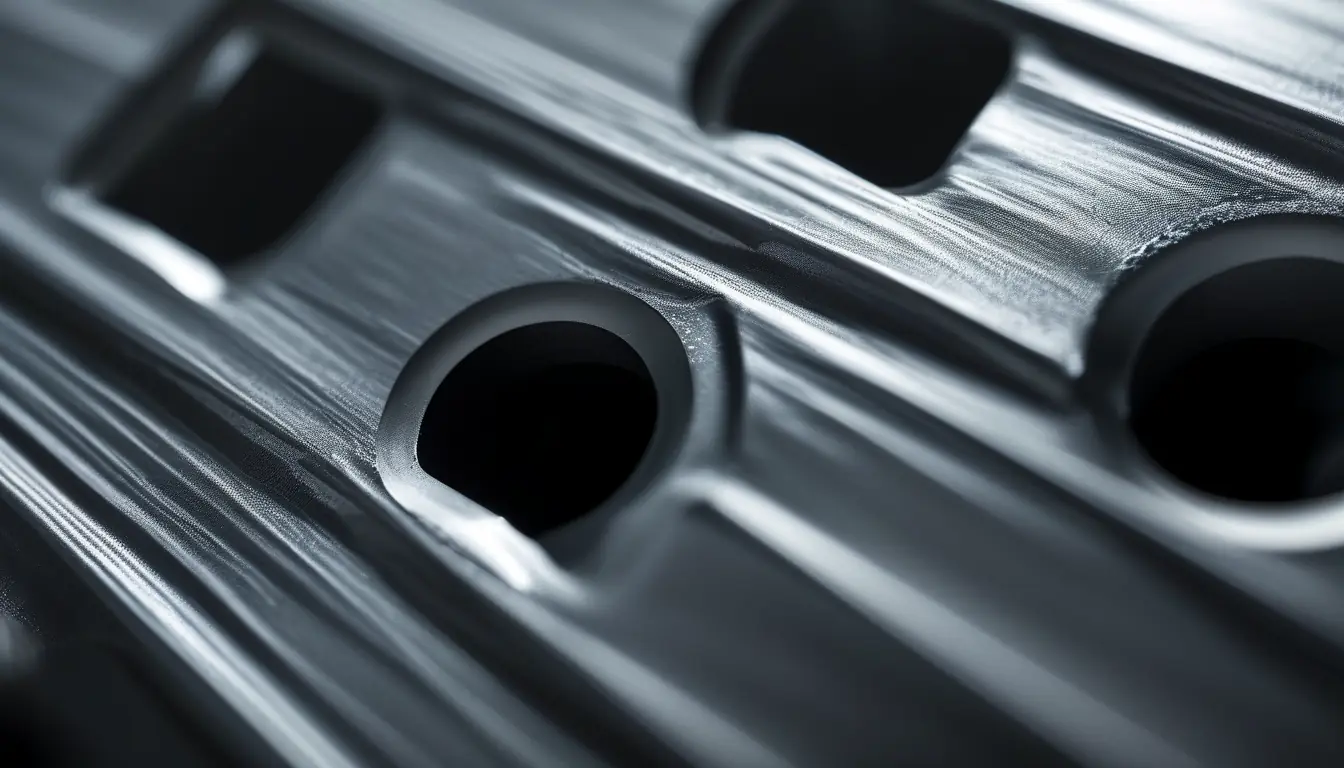
Decision Framework: Which Process for Your Perforated Panels
Pick punching when:
- Holes are standard round/square/obround at one fixed pitch.
- Quantity is high (as a rule of thumb: total hole count well above ~100,000, or repeat production over months).
- Sheet thickness is within turret capacity (typically ≤ 6–8 mm depending on press tonnage [3]).
- Edge appearance is secondary (e.g. hidden filtration or acoustic backing panels).
Pick laser when:
- The pattern is custom, artistic, graduated, or includes non-round holes.
- Quantities are low-to-medium or this is a first-off project panel.
- Hole size or plate thickness is outside the punch tool library.
- You need the contour of the panel itself cut in the same setup (laser does holes + outline + cutouts in one file, one setup).
Hybrid approach:
For some heavy-volume architectural projects the smart money is both: punch the standard perforation field, then laser-trim the panel outline, cut corners, and add fixing slots. If you are unsure, send the drawing and quantity — we quote both routes and show the crossover on your actual numbers.
Perforated panels most often end up as building products: facade screens, sun shades, balustrade infill, acoustic linings. Our laser cut metal screens buyer’s guide covers material grades, mounting systems, and finishes for exactly those applications.
Quality: What to Put in the Purchase Order
Whichever process you choose, specify rather than assume:
- Tolerances. Hole diameter ±0.1–0.2 mm is realistic for both processes on sheet up to 3 mm; pitch tolerance matters more than hole size for visual patterns. General unmachined-part tolerances can be referenced to ISO 2768 classes [4].
- Burr / dross limit. For laser: “deburred, dross-free, touch-safe edges.” For punching: “exit burr ≤ 0.1 mm” or specify secondary deburring.
- Flatness. State a delivered flatness (e.g. ≤ 3 mm per 2 m) — heavily perforated thin sheet loves to ripple.
- Pattern orientation and start datum. Sounds trivial; prevents half-a-hole surprises at panel edges.

Frequently Asked Questions
Is laser perforation more expensive than punching?
Per hole on a long identical run, yes. But for custom patterns or runs under a few thousand sheets, laser usually wins overall because there is no tooling cost and no setup charge per hole size.
What is the smallest hole you can laser cut in steel sheet?
As a rule, hole diameter ≥ sheet thickness. In 2 mm sheet we reliably cut 2 mm holes and prefer 3 mm; in 6 mm plate, keep holes ≥ 6–8 mm for a clean edge.
Can you perforate and cut the panel outline in one operation?
With laser, yes — holes, outline, cutouts and fixing slots come from one file in one setup. Punching usually needs a second operation or shear for the outline.
Which process gives a better edge for powder coating?
Both coat well if deburred. Laser edges are slightly rougher thermally but consistent; punched edges have sheared rolloff. For exterior coated panels, specify deburr + edge-rounding either way.
Do you need our CAD file, or can you work from a concept?
Send what you have. A DXF with true hole geometry is ideal; for concept-stage projects we can generate the perforation pattern from your open-area target and image reference, then send the file back for approval.
References
- TWI Ltd. “What is Laser Cutting? A Definitive Guide to the Process.” TWI Technical Knowledge FAQs. https://www.twi-global.com/technical-knowledge/faqs/what-is-laser-cutting (accessed August 9, 2026).
- ISO. “ISO 9013:2017: Thermal cutting — Geometrical product specification and quality tolerances.” International Organization for Standardization, 2017. https://www.iso.org/standard/60321.html (accessed August 9, 2026).
- Wilson Tool International. “Sheet Metal Punching Tooling Solutions.” Wilson Tool. https://wilsontool.com/en-us/solutions/punching (accessed August 9, 2026).
- ISO. “ISO 2768-1:1989: General tolerances — Part 1: Tolerances for linear and angular dimensions without individual tolerance indications.” International Organization for Standardization, 1989. https://www.iso.org/standard/7748.html (accessed August 9, 2026).
- The Mesh Company. “Punching vs. Laser Cutting: An In-Depth Analysis of Metal Fabrication Techniques.” The Mesh Company. https://themeshcompany.com/punching-vs-laser-cutting-an-in-depth-analysis-of-metal-fabrication-techniques/ (accessed August 9, 2026).