Choosing the right cutting technology isn’t a classroom exercise — it’s a per-part cost decision that impacts your lead time, edge quality, secondary processing budget, and ultimately your margin. Three processes dominate industrial metal cutting: fiber laser, plasma, and waterjet. Each has a clear sweet spot. At Zemlaser, we run 10+ fiber lasers daily and regularly advise B2B buyers on when to use which process — including when the best answer isn’t laser at all.
Fiber Laser Cutting: Precision at Speed
Fiber lasers amplify light through doped optical fibers, delivering a focused beam with exceptionally high power density. The result: clean, narrow kerfs at high feed rates on sheet and plate up to 150 mm in stainless steel.

How It Works
A solid-state laser source (1–20 kW typical) pumps light into a doped fiber. The amplified beam exits through a cutting head with assist gas — oxygen for mild steel, nitrogen for stainless and aluminum. The gas ejects molten material and cools the kerf edge. Because fiber lasers operate at a wavelength (~1.07 μm) that metals absorb efficiently, they cut reflective materials (aluminum, brass, copper) that CO₂ lasers struggled with.
Fiber Laser Advantages
- Tight tolerances: ±0.1 mm standard, ±0.05 mm achievable on thin sheet. Compare that to ±0.5 mm typical for plasma.
- Excellent edge quality: Nitrogen assist produces oxide-free, weld-ready edges on stainless — no secondary grinding needed.
- Thin-to-thick range: One machine cuts 0.5 mm shim stock and 150 mm boiler plate. No process changeover.
- Speed: Up to 40 m/min on thin sheet. A 3 mm stainless bracket cuts in seconds.
- Low heat input: Small HAZ (heat-affected zone). Minimal distortion. No micro-cracking.
- Reflective metal capable: Modern fiber lasers include back-reflection protection, making aluminum, brass, and copper routine.
- Operating cost: No consumables beyond assist gas and nozzles. Electrical efficiency 30–40% (vs. 10% for CO₂).
Fiber Laser Limitations
- Thickness ceiling: 150 mm stainless / 80 mm carbon steel. Beyond that, plasma or waterjet.
- Not ideal for materials that melt rather than vaporize cleanly (some plastics, composites).
- Initial capital cost is higher than plasma — but per-part cost is lower at volume.
Best for: Precision sheet metal parts, brackets, enclosures, panels, flanges, gussets — from prototype to 100,000+ production run. This is where Zemlaser’s 10+ fiber lasers operate daily for OEM and export B2B orders.
Plasma Cutting: Thick Plate Economics
Plasma cutting ionizes a gas (compressed air, nitrogen, or oxygen) through a constricting nozzle to create an electrically conductive plasma arc reaching 20,000°C+ (Wikipedia: plasma cutting). The arc melts the workpiece, and the high-velocity gas jet blows the molten metal through the kerf.
Plasma Advantages
- Thick plate capability: Cuts 160 mm+ carbon steel. Industrial plasma tables handle plate thicknesses no laser can touch.
- Low equipment cost: A capable plasma table is 1/3 to 1/5 the capital investment of an equivalent-power fiber laser.
- Forgiving on material condition: Rust, mill scale, and light paint don’t significantly affect cut quality — unlike laser, which needs clean surface for consistent coupling.
- Bevel cutting: Plasma torches can be angled for weld-prep bevels — a feature laser cutting heads don’t offer.
Plasma Limitations
- Tolerance: ±0.5 mm typical. Expect edge bevel of 1–4° depending on material thickness. Not suitable for precision-fit parts.
- HF (High Frequency) start: Traditional plasma uses HF ignition that can interfere with CNC electronics. Modern “blowback” start torches mitigate this.
- HAZ and dross: Larger heat-affected zone. Bottom-edge dross requires grinding or chipping for many applications.
- Minimum thickness: Below 3 mm, plasma struggles — the arc wanders, kerf width becomes a significant fraction of material thickness, and distortion is severe.
Best for: Heavy steel fabrication — machine frames, structural beams, shipbuilding plate, bridge components. When you need 40 mm carbon steel cut fast and edge bevel is acceptable, plasma wins on cost.
Waterjet Cutting: Cold, Universal
Waterjet cutting uses a 4,000-bar (60,000 psi) water stream mixed with garnet abrasive. There is no heat — material is removed by supersonic erosion. The waterjet cutting process is governed by ISO 9013 tolerance standards for thermal and non-thermal cutting. Because there’s no thermal input, there’s zero HAZ, no microstructural change, no warping, and no oxide layer.
Waterjet Advantages
- Any material: Metals, stone, glass, ceramics, composites, rubber, plastics, laminates, food. Thickness up to 200 mm in steel.
- Zero heat: No HAZ. No hardening. No distortion. Critical for titanium aerospace components, tool steels that cannot see any thermal cycle, and multi-layer laminates.
- No material property changes: Cut edge retains base material hardness and grain structure. No recast layer. No micro-cracks.
- Stack cutting: Multiple sheets can be stacked and cut simultaneously — offsetting the slower per-part cycle time.
- Narrow kerf: 0.5–1.5 mm typical, comparable to laser on thin stock.
Waterjet Limitations
- Speed: Significantly slower than laser on thin sheet. A part that takes 30 seconds on fiber laser might take 3 minutes on waterjet.
- Operating cost: Garnet abrasive is a consumable. Pump seals and mixing tubes wear and require regular replacement.
- Wet process: Parts and work area are wet post-cut. Requires drying before welding or coating. Some materials (mild steel) flash-rust if not dried promptly.
- Taper: Waterjet kerfs exhibit a slight V-shape (wider at top). Modern dynamic tilt heads compensate, but taper remains a consideration on very thick stock.
Best for: Aerospace titanium, thick tool steels, multi-material stacks, stone countertops, glass art, composite trimming — any application where heat is unacceptable or the material range exceeds what thermal processes can handle.
Head-to-Head Comparison
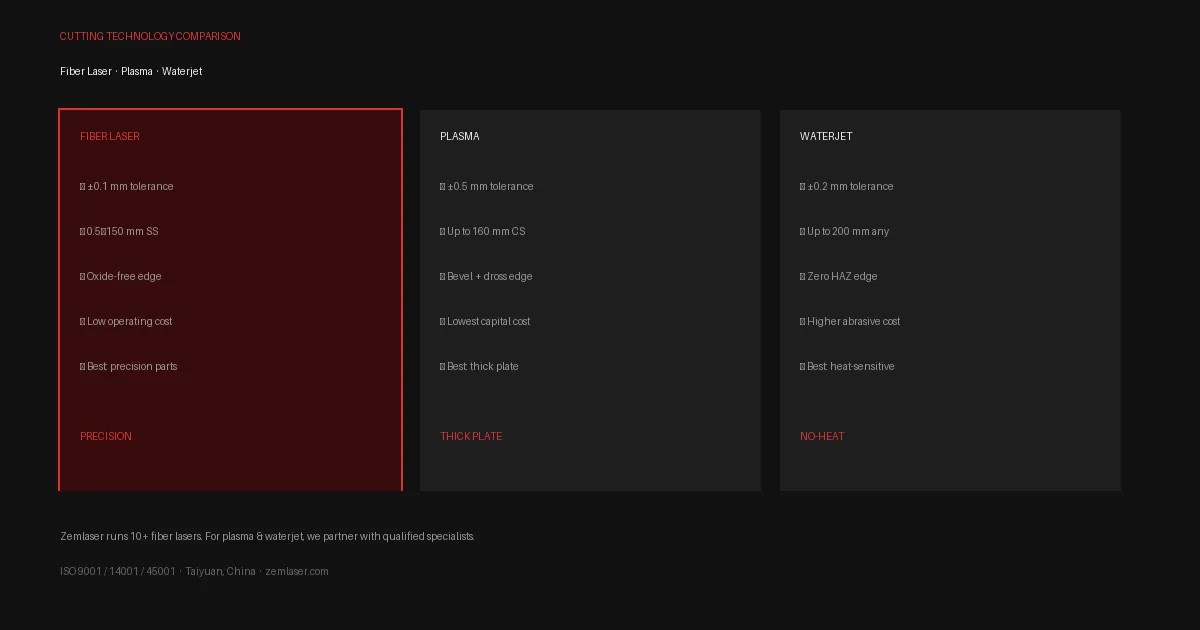
| Criterion | Fiber Laser | Plasma | Waterjet |
|---|---|---|---|
| Max SS thickness | 150 mm | 80 mm | 200 mm |
| Tolerance | ±0.1 mm | ±0.5 mm | ±0.2 mm |
| Edge quality | Excellent | Fair (bevel + dross) | Good (no HAZ) |
| HAZ | Minimal | Significant | Zero |
| Speed (3mm SS) | ~25 m/min | N/A (min 3mm) | ~0.3 m/min |
| Materials | Metals only | Conductive metals | Any material |
| Operating cost | Low-medium | Low | High (abrasive) |
| Reflective metals | Yes (modern) | No | Yes |
How to Choose: A Decision Framework
Choose Fiber Laser When:
- Material is metal and thickness is ≤150 mm stainless / ≤80 mm carbon steel
- Edge quality and ±0.1 mm tolerance are gating requirements
- Volume is medium to high — per-part cost drops with speed
- Parts require minimal secondary finishing (no deburr, no grinding)
- You need quick-turn prototyping AND scalable production from the same process
Choose Plasma When:
- Material is thick carbon steel (>40 mm) where edge bevel is acceptable
- Per-part cost is the dominant decision factor
- Material surface condition is poor (rust, scale) and you don’t want to pre-clean
- You need weld-prep bevel cuts in a single pass
- Part tolerances above ±0.5 mm are acceptable
Choose Waterjet When:
- Material is not metal — stone, glass, composite, rubber
- Material is heat-sensitive — titanium aerospace, hardened tool steel, titanium alloys
- No HAZ is an absolute requirement (aerospace, medical implant, nuclear)
- You’re cutting very thick stock (>150 mm) regardless of material
- Multiple stacked sheets can offset the slower per-part speed
Why Zemlaser Standardized on Fiber Laser

We operate 10+ fiber laser machines ranging from 1 kW to 20 kW on a single factory floor in Taiyuan, Shanxi, China. Our manufacturing capabilities span 0.5 mm shim stock to 150 mm stainless steel plate. For 90% of the metal materials our B2B export clients order — stainless 304/316L, carbon steel, aluminum, titanium — fiber laser delivers the optimal balance of precision, speed, and per-part economics.
When a project exceeds our laser envelope — thick structural plate, exotic non-metal materials, or zero-HAZ titanium — we partner with qualified plasma and waterjet specialists to offer a complete solution. One PO. One point of contact. No process finger-pointing.
Our ISO 9001/14001/45001 certified quality system applies regardless of the cutting method. See our About page for factory details and terms of service for order terms including our standard 7-day FOB Tianjin lead time.
Have a part and not sure which process fits? Upload your drawing — our engineers will recommend the right method and quote within 24 hours. DXF, DWG, STEP, PDF accepted. Free. No obligation.
Frequently Asked Questions
Is fiber laser more expensive than plasma?
Per-part, fiber laser is often cheaper at volumes above 50–100 units because speed and edge quality eliminate secondary grinding and deburring. Plasma has a lower machine hourly rate but the total cost per finished part — including labor for dross removal and tolerance correction — frequently favors laser for sheet-metal-gauge work. For thick structural plate (>40mm), plasma wins on total cost.
Can I get waterjet-quality edges from laser cutting?
On metals, yes — for most applications. Nitrogen-assisted fiber laser produces clean, oxide-free edges that require no post-processing. The difference matters only in niche cases: titanium parts that will undergo subsequent heat treatment, tool steels sensitive to any thermal cycle, or materials where the microscopic recast layer (typically 5–20 μm on laser) is unacceptable. In those cases, waterjet is specified for zero thermal influence.
What file formats do you need for a quote?
We accept DXF, DWG, STEP, IGES, and PDF. For laser cutting specifically, a 2D DXF at 1:1 scale in millimeters is ideal for flat parts. For parts requiring bending or multiple processes, send a STEP file so our engineers can assess the full 3D geometry. Read our DXF vs STEP guide for details.
Can you handle both prototyping and production?
Yes. Our 1-piece MOQ means we’ll cut a single prototype part for your approval. The same fiber laser machine and QC process that cut your prototype also run your 10,000-piece production order. No process drift. No requalification. See our laser cutting services for full capability details.