Perforated metal is one of those products where the buying conversation goes wrong early: someone asks for “perforated sheet”, a supplier quotes a stock pattern, and three weeks later the panel arrives with the wrong pitch, the wrong open area, or holes too close to the edge. The fix is simple — perforation is fully specifiable in five numbers, and laser cutting means all five are free to choose because there is no tooling to constrain them.
This guide covers the pattern catalog, the open-area math buyers actually need, the thickness range laser perforation handles, and the ordering checklist. If you are still deciding between laser and punching for your job, read our laser vs punching comparison first — this article assumes laser is the process and focuses on specifying the product.
1. Why Laser Changes What You Can Ask For
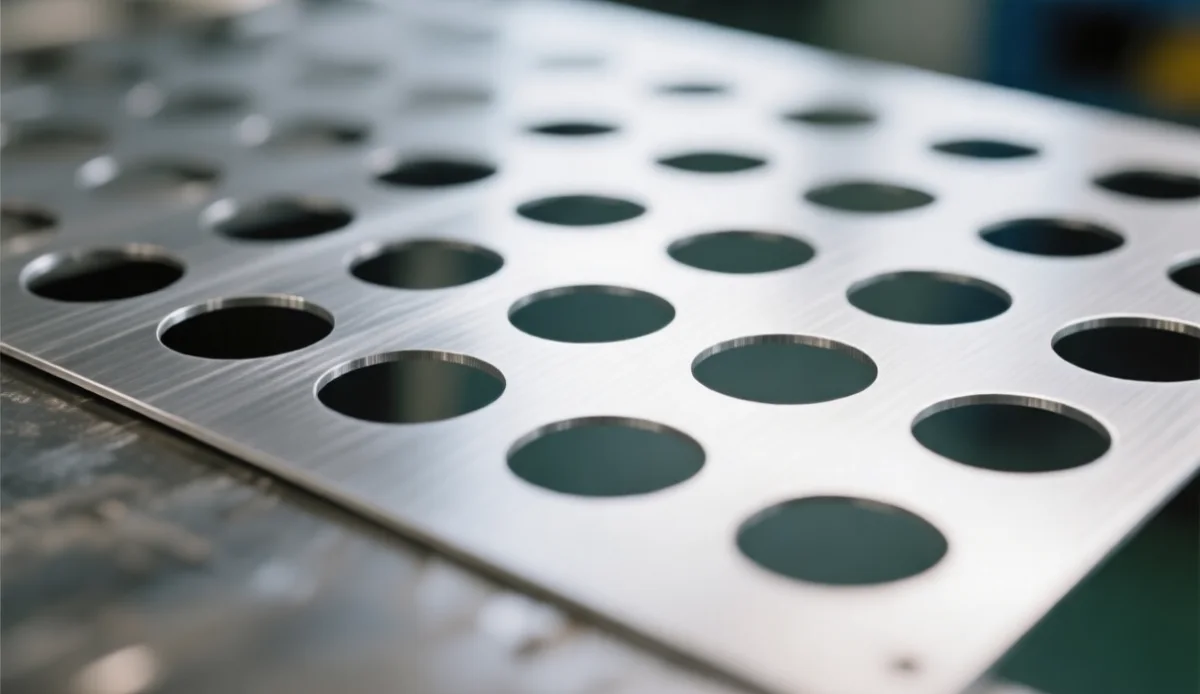
Punch perforation is bound by the tools in the turret: standard hole sizes, standard pitches, and economics that only work at volume. Laser perforation removes every one of those constraints:
- No tooling: hole size, pitch and pattern live in a CAD file; changing them costs nothing.
- Micro holes: round holes from 0.5 mm in thin sheet are routine — below practical punch range without expensive fine-punch tooling.
- Any geometry: graduated hole patterns, logo-shaped perforation zones, variable pitch for acoustic tuning — all just file changes.
- Thick plate: perforation up to 20 mm plate where punching is impossible and drilling is slow.
- Prototypes and short runs: one sheet costs the same per-hole as a thousand.
The trade-off is per-hole cycle time: thousands of holes on thick plate take real machine minutes, so quotation time scales with hole count × thickness. That is exactly why the spec should be intentional — over-perforating “just in case” is the most common way to double your own price.
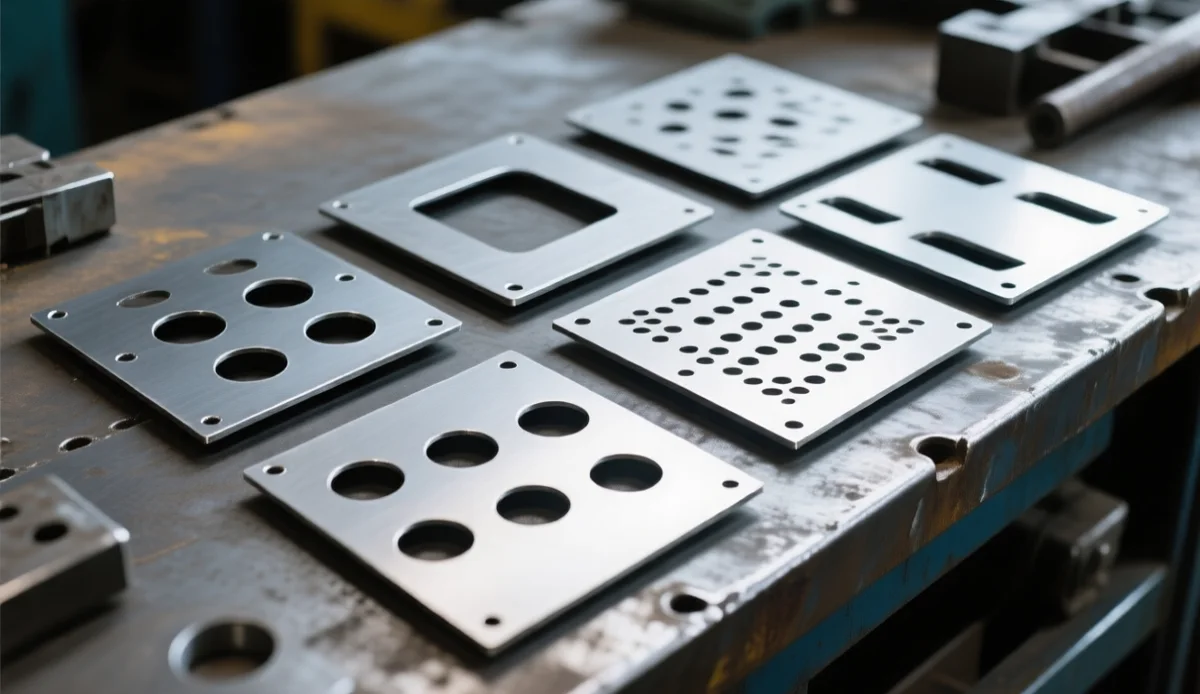
2. The Pattern Catalog: Six Standards and When to Use Each
| Pattern | Typical geometry | Best for |
|---|---|---|
| Round holes, 60° staggered | Hole Ø + pitch in triangular array | The default: best open area for a given ligament strength; screens, filters, facades |
| Round holes, straight (square array) | Aligned rows and columns | Architectural panels where visual order matters more than max open area |
| Square holes | Side + pitch | Sizing/sorting screens, grilles, higher open area than round at equal ligament |
| Slot / oblong holes | Width × length + pitch | Dewatering and sizing screens, ventilation louvres, directional flow |
| Micro perforation | Ø 0.5–1.5 mm, tight pitch | Acoustic absorber panels, spark arrestors, fine filtration, speaker grilles |
| Decorative / custom | Any vector shape | Facades, balustrades, design features — laser-only territory |
60° staggered round is the default for a reason: for the same hole size and ligament (the material between holes), the triangular array yields more open area and more uniform strength. When a drawing simply says “perforated” without a pattern, this is what most fabricators will quote — say otherwise if you mean otherwise.
3. Open Area: The Number That Drives Everything
Open area percentage is the share of the sheet that is hole. It governs airflow, drainage, visibility, acoustic transparency — and it subtracts directly from mechanical strength. It is also trivial to calculate, which makes it the single best number to put on your RFQ.
3.1 The formulas
Round holes, 60° staggered: OA% = 0.9069 × (D ÷ P)² × 100
Round holes, straight pitch: OA% = 0.7854 × (D ÷ P)² × 100
where D = hole diameter, P = center-to-center pitch.
Worked example: Ø5 mm holes on 8 mm staggered pitch: OA = 0.9069 × (5/8)² × 100 ≈ 35.4%. Move the pitch to 7 mm and open area jumps to ≈ 46.3% — a one-millimeter pitch change moves airflow by nearly a third. This is why pitch belongs on the drawing and not “to supplier’s standard”.
3.2 The trade-offs to balance
| Open area | What it gives you | What it costs you |
|---|---|---|
| 10–25% | Strength, screening, shading | Restricted airflow, heavier panel |
| 25–40% | The all-round band for screens and facades | Moderate stiffness loss; may need stiffening frames |
| 40–60% | Maximum airflow/drainage, light weight | Significant strength loss; edge margins critical |
| >60% | Specialty: filtration media, acoustic faces | Very fragile; handling and frame design dominate |
Rule of thumb for structural use: keep ligament (P − D) at least equal to sheet thickness, and check panel stiffness before committing to open areas above 40%. Your supplier should be able to sanity-check this against the application in one email — if they cannot, that tells you something.
4. Thickness Range: What Laser Perforation Actually Handles
| Thickness | Practical hole range | Notes |
|---|---|---|
| 0.5–1.5 mm sheet | Ø from 0.5 mm (micro perf) | Fast, cheap per hole; watch heat distortion on dense patterns |
| 2–6 mm | Ø from ~thickness up to any size | The sweet spot: quality, speed and cost all favorable |
| 8–12 mm | Ø ≥ thickness recommended | Per-hole time climbs; expect slight taper (kerf geometry) |
| 15–20 mm plate | Ø ≥ 1.2× thickness recommended | Laser-only territory vs punching; dross check on mild steel, slower speeds |
| >20 mm | Case-by-case | Drilling or plasma + machining usually wins on cost |
Two engineering rules do most of the work: keep the hole diameter at least equal to sheet thickness (below that, pierce quality and tip wear fight you), and keep hole-to-hole and hole-to-edge ligaments ≥ thickness to hold dimensional accuracy. General dimensional tolerance follows ISO 2768-1 classes unless you spec tighter — state the class on the drawing. Cut-edge quality expectations for the perforation itself can reference thermal-cutting quality grades per ISO 9013 if your application needs it (e.g., fatigue-sensitive or visible-edge work). For the raw cutting-thickness capabilities of the machines themselves, see our fiber laser thickness guide.
5. Materials
| Material | Why it’s chosen | Laser notes |
|---|---|---|
| Stainless 304 | Architectural panels, food screens, general corrosion resistance | Nitrogen cut for bright oxide-free holes |
| Stainless 316L | Marine, chemical, coastal facades | Same; chloride environments justify the premium |
| Mild steel (S235/S355) | Mining screens, machine guards, cost-driven work | Oxygen cut; expect oxide on hole edges unless post-treated |
| Aluminum 1xxx/5xxx | Weight-sensitive facades, acoustics | Reflectivity handled fine on modern fiber lasers |
| Galvanized sheet | Outdoor HVAC, drainage | Zinc fume extraction matters; hole edges lose coating |
Grade selection follows the same logic as any fabrication job — our materials page covers the full range, and the 304-vs-316L decision turns on chlorides and environment as always.
6. Applications That Drive the Spec
- Screens and sorting (mining, aggregate, recycling): slot or square holes, 3–12 mm plate, open area tuned to throughput vs wear life.
- Architectural facades and balustrades: decorative or staggered round, 1.5–4 mm sheet, appearance-grade edge and finish.
- Acoustic panels: micro perforation (Ø 0.5–1.5 mm, 1–15% open area) as the absorption face over insulation.
- Filtration and spark arrestors: fine hole arrays where hole-size consistency is the whole point.
- Machine guards and ventilation panels: the cost-driven middle band where stock patterns often suffice — laser wins when cutouts, notches and mounting holes must land in the same setup.
7. Ordering Checklist: Everything a Quote Needs
- Hole size and pattern (Ø or dimensions, staggered/straight/square/slot/custom).
- Pitch (center-to-center) — or target open area % and let the supplier back-solve the pitch.
- Material and thickness (grade + standard, e.g. S235JR / 304 per EN 10029).
- Sheet size and perforated zone — full sheet or a defined zone; unperforated margins (keep ≥ 20 mm or ≥ 2× thickness unless discussed).
- Quantity — affects only price, never tooling.
- Edge and finish requirements — deburring level, surface finish, coating compatibility.
- File format — 1:1 DXF is fastest to quote; see our DXF vs STEP guide for what each format is good for.
One sentence saves a lot of emails: “State open area % and ligament on the quote, not just hole size.” It forces the arithmetic into the open and catches pitch mistakes before cutting.
FAQ
What is the smallest hole a laser can perforate?
Ø 0.5 mm is routine in sheet up to about 1.5 mm; 1 mm holes are comfortable to about 3 mm thickness. Below Ø 0.5 mm the process moves toward micro-laser territory with different economics.
How thick can perforated plate be laser cut?
Practically to 20 mm with hole diameters at least equal to (ideally 1.2×) plate thickness. Beyond that, drilling or plasma-plus-machining usually costs less per hole.
How do I calculate open area?
For 60° staggered round holes: OA% = 0.9069 × (hole Ø ÷ pitch)² × 100. Straight arrays use 0.7854 instead of 0.9069. Every other pattern (square, slot) has its own one-line version — ask your supplier to print the result on the quote.
Does perforating weaken the sheet?
Yes — cross-sectional area drops roughly in proportion to open area, and stress concentrates at hole edges. Keep ligament ≥ thickness for structural panels, and above 40% open area treat the panel as a specialized component, not sheet.
Laser or punching for my perforated sheet?
Punching wins on very high volumes of standard patterns in thin sheet; laser wins on custom patterns, micro holes, thick plate, prototypes, and combined features (cutouts + holes in one setup). Full breakdown in our laser vs punching guide.
What drives the price of laser perforation?
Hole count × thickness (machine time), material, and sheet size — in that order. Pattern complexity is nearly free. The fastest way to lower cost is fewer or larger holes, not negotiation.
Need perforated panels cut to spec?
Send hole size, pitch, material, thickness and quantity — free quote in 24 hours, open area calculated and printed on the offer.
GET A FREE QUOTE →