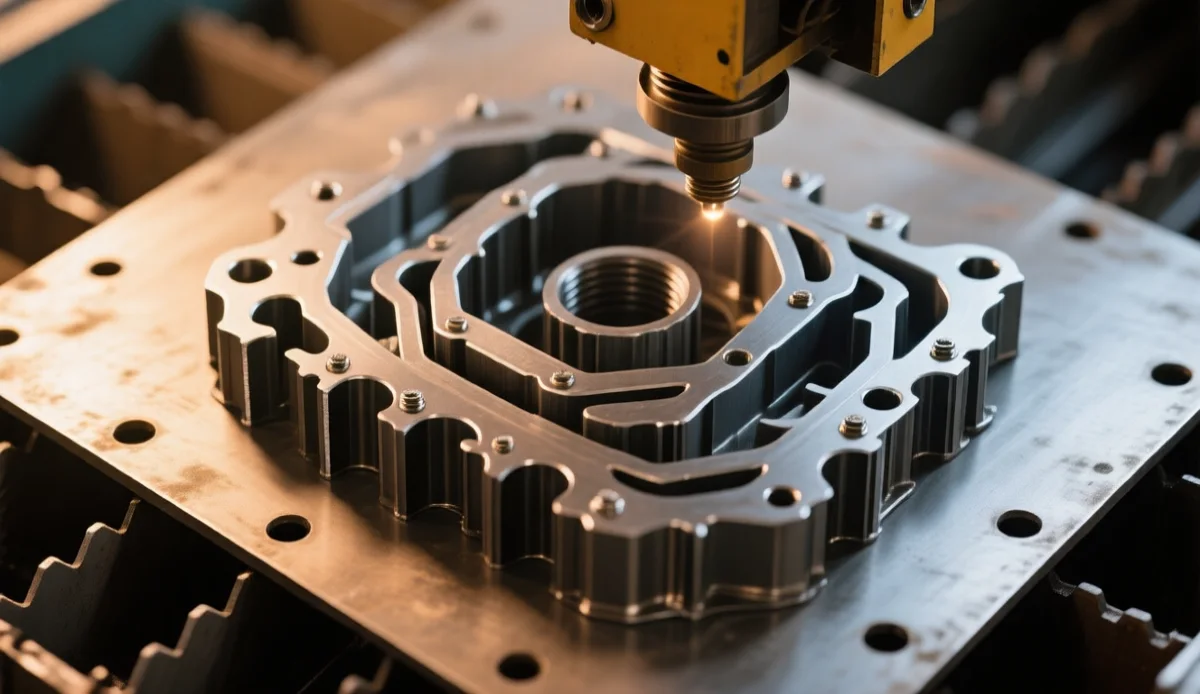
TL;DR: Laser profiling and laser cutting are the same service — a fiber laser following CNC paths through plate. “Profiling” is simply the UK / Australian / Indian trade term, and it emphasizes full 2D shapes (profiles) rather than straight cuts. If your RFQ says profiling, quote it exactly as you would laser cutting: same machines, same tolerances, same price drivers. The word that matters is not the verb but the drawing.
1. Two Names, One Process
Both terms describe a focused fiber laser beam tracing programmed contours through metal plate. The difference is regional habit, not physics:
| Term | Common in | Connotation |
|---|---|---|
| Laser cutting | US, international trade | Generic — straight cuts, profiles, holes, all of it |
| Laser profiling | UK, Australia, India, South Africa | Profile-first: shaped parts rather than rectangles |
| Laser burning (flame) | Older UK usage | Historically oxy-fuel; avoid mixing with fiber terminology |
One genuine historical distinction to know: British “profiling” companies grew out of oxy-fuel flame cutting for heavy structural plate, so older buyers may assume profiling includes very thick sections (50–100 mm by flame or plasma). If your project spans thickness ranges, state the process per thickness band — our process comparison guide maps where fiber hands over to plasma.
2. What Profiling Shops Actually Deliver
The service bundle behind the name typically includes:
- Full 2D profiling — any contour, internal cutouts, hole patterns, weld-prep notches
- Nesting across orders — multiple customers’ parts on one plate to absorb skeleton scrap
- Material supply — shop-owned stock certified by mill test certificate, or customer-supplied plate
- Edge work on request — deburring, countersinking, beveling (beveled weld prep often moves to plasma or machining above 20 mm)
Tolerances, edge quality, and pricing mechanics are identical to laser cutting under any other name — ±0.5 mm commercial standard on steel up to 12 mm, kerf compensation applied by the CAM, as detailed in our tolerance guide.
3. Buying Profiling Services: The RFQ Checklist
UK / Australian / Indian RFQs for profiling carry a few regional expectations worth meeting:
| RFQ line | What a good answer looks like |
|---|---|
| Drawing format | Accept DXF/DWG 1:1 plus PDF for context; offer to convert STEP for a stated fee |
| Material certification | MTR per heat number as default; EN 10204 3.1 offered where specified |
| Tolerance call-out | Quote ISO 9013 range explicitly rather than “standard tolerance” |
| Delivery terms | Ex-works lead time + crate dimensions; export buyers need packing spec up front |
| Batch pricing | Tiered rates at 1×/5×/20× quantities — profiling work scales by nesting, not just time |
For buyers sourcing outside their home region — UK and Australian importers routinely profile through Chinese shops — the checklist in our cut-to-size buyer’s guide transfers directly: sample batch first, heat-number verification, packing spec, price validity.
4. Profiling Economics: Why Nesting Beats Per-Part Thinking
The unit of profitability in profiling is the plate, not the part. Two parts-per-sheet layouts can differ by 25% in material cost before any machine time is considered. What that means when quoting:
- Mixed-size orders price best. Small parts fill the gaps around large ones; a plate of one part size carries its whole skeleton as cost.
- Common thickness consolidates. Every gauge change is a setup; group parts by thickness across your whole project, not per assembly.
- Skeleton policy should be written down. Who owns (and pays for) the leftover plate — you, the shop, or shared — decides the real price more than the hourly rate does.
Speed and parameter behavior by thickness follow the same physics everywhere; our thickness and speed charts let you sanity-check quoted lead times against realistic cutting speeds.
5. Choosing a Profiling Partner: Capability Questions That Matter
Five questions that separate capable shops from resellers:
- What power class runs my thickness band? — 6 kW handles ≤12 mm well; 20 mm work wants 12 kW+ or honest handover to plasma
- How do you manage heat on thin parts? — micro-joint and sequencing answers reveal real thin-sheet experience
- Can you show measurement records? — CMM or calibrated inspection logs on request
- What is your gas supply? — bulk liquid nitrogen capability matters for stainless volume
- Do you cut customer-supplied plate? — yes-with-conditions is the honest answer (flatness and surface checks before acceptance)
Resellers will answer all five fluently from a brochure; shops answer with numbers, caveats, and the occasional “we would not do it that way.” The latter is what you want holding your tolerances.
FAQ
Is laser profiling the same as laser cutting?
Yes — profiling is the UK, Australian, and Indian trade term for CNC laser cutting of 2D shapes. Same machines, same tolerances, same price drivers; only the vocabulary differs.
What does laser profiling cost?
The same as laser cutting: per-meter cutting rates by thickness plus material. Mild steel profiling runs roughly $0.60–4.00/m for 3–10 mm ex-works China; stainless costs 1.5–2× mild at equal thickness.
What thickness can laser profiling handle?
Fiber profiling is economical to about 20–25 mm; beyond that, traditional flame or plasma profiling takes over — many profiling shops run both and route each part to the right process.
What file format does a profiling shop need?
1:1 DXF or DWG for the cut paths, plus a PDF drawing for tolerances and notes. STEP files work too and carry more information if bending or machining follows.
Do profiling services include material?
Usually yes — shops quote supplied-and-cut as standard, with MTRs by heat number. Customer-supplied plate is generally accepted subject to flatness and surface inspection.
Profiling RFQ in hand? Send the drawings through our quote form — we answer with the same numbers your local profiler would, at plate-level nesting, within 24 hours.
References
- ISO. “ISO 9013:2017 Thermal cutting — Classification of thermal cuts.” ISO, 2017. iso.org/obp (ISO 9013) (accessed Aug 29, 2026).
- Zemlaser. Internal quotation database, profiling job-work pricing, accessed Aug 29, 2026.(第一手报价数据,本网站)
- Zemlaser. “Fiber Laser vs Plasma vs Waterjet: The Complete Comparison.” zemlaser.com, 2026.(本站指南,正文已内链)