TL;DR: “Steel plate cut to size” means buying whole plates broken down into rectangles, blanks, or profiled parts sized to your drawing — instead of paying for full sheets you will mostly scrap. Laser is the default process below about 20 mm because it holds ±0.5 mm, needs no tooling, and nests mixed sizes on one plate. Pricing runs per cutting meter plus material; expect roughly $0.60–4.00/m for 3–10 mm mild steel ex-works China, with minimum order charges on small jobs.
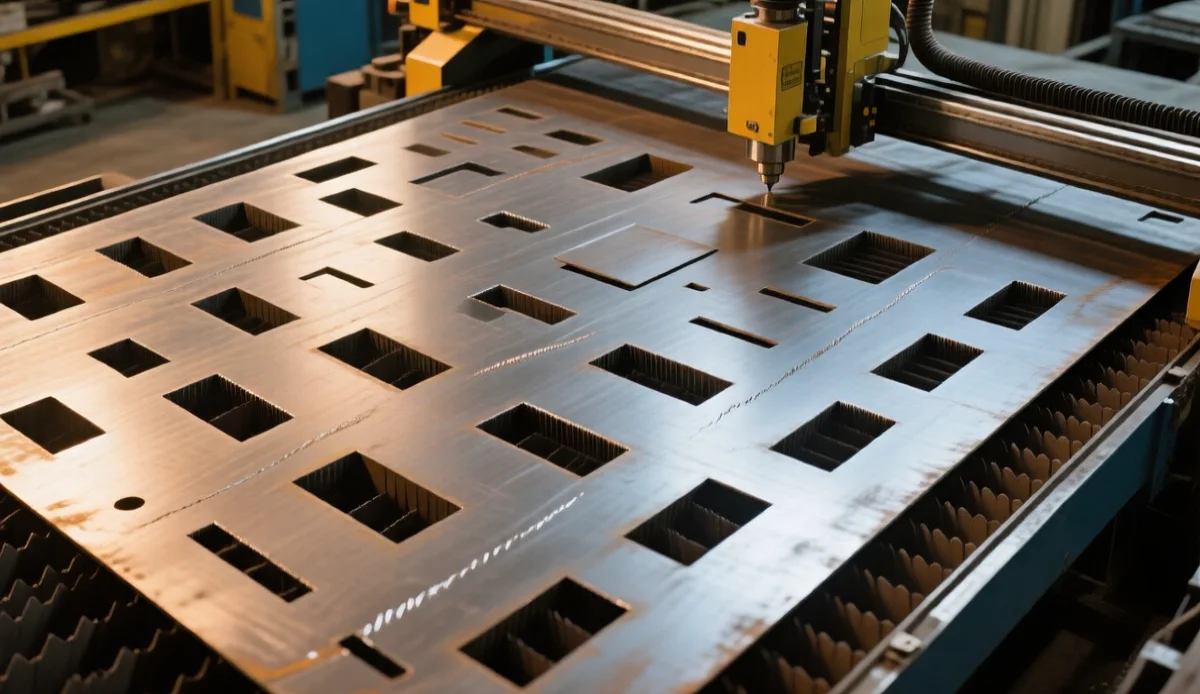
1. What “Cut to Size” Actually Means
Mills and stockists sell plate in standard mill sizes — commonly 1,500 × 6,000 mm or 2,000 × 6,000 mm. Most fabricators do not need a full plate; they need ten 480 × 620 mm blanks, or a batch of flanges, or strips for rolling. Cut-to-size service bridges that gap: the supplier takes your dimension list, nests it onto stock plates, cuts, and ships only the pieces you ordered.
Terminology varies by region, and it confuses procurement teams:
| Term | Where you hear it | What it usually means |
|---|---|---|
| Cut to size / cut to length | US, international trade | Rectangles, strips, blanks from stock plate |
| Laser profiling | UK, Australia, India | Same service, emphasis on profiled (non-rectangular) parts |
| Multiblanking | Supplier-side jargon | Cutting many small blanks from one plate run |
| Sheared plate | Stockists | Guillotine-cut rectangles only, looser tolerance |
All four overlap. When requesting quotes, send dimensions and quantities — the label matters less than the drawing.
2. Which Process Should Cut Your Pieces?
Three processes dominate cut-to-size work, and the right one depends on thickness, tolerance, and edge quality — not on habit:
| Factor | Laser | Shearing | Plasma |
|---|---|---|---|
| Practical thickness | 0.5–25 mm (sweet spot ≤20 mm) | ≤25 mm, straight lines only | 6–100 mm+ |
| Tolerance | ±0.2–0.5 mm typical | ±1–2 mm | ±1–3 mm |
| Shapes | Any 2D profile, holes, slots | Rectangles and strips only | Any profile, coarse |
| Edge quality | Weld-ready | Shear droop on thick plate | Bevel + dross, needs grinding |
| Setup cost | None (file-driven) | None | Low |
| Best for | Blanks with holes, mixed sizes, tight tolerance | Big simple rectangles, cheapest per cut | Thick plate where laser is slow |
We run the full comparison — including cost crossover points — in our fiber laser vs plasma vs waterjet guide. The short version: below 12 mm, laser almost always wins the finished-part economics; shearing wins on plain rectangles above 100 pieces; plasma takes over beyond 25 mm.
3. How Cut-to-Size Pricing Works
Three billing models appear in quotes. Knowing which one you are looking at prevents comparing apples with oranges:
| Billing basis | How it works | Watch out for |
|---|---|---|
| Per cutting meter | Total cut length × rate by thickness | Pierce-heavy parts (many holes) may carry extra |
| Per kg of finished parts | Material + cutting bundled per weight | Nesting scrap may or may not be billed to you |
| Per part | Fixed piece price | Revisions reset the price; confirm revision policy |
A worked example
Twenty blanks, 480 × 620 mm, 6 mm mild steel S235JR. Outline per blank is 2.2 m, so 44 m of cutting total. At a typical $1.50/m for 6 mm, cutting is about $66; the material for twenty blanks plus nesting allowance runs roughly $250–300 at current plate prices. A realistic ex-works quote lands near $16–19 per blank. Order the same pieces as 500, and nesting density improves and fixed costs spread — per-piece price usually drops 15–25%.
Two cost drivers buyers miss: scrap policy (do you pay for the skeleton left after your blanks are cut out? good suppliers nest multiple customers’ jobs to absorb it) and minimum charges (jobs under roughly $100–150 of cutting time often get a floor charge, because setup and handling dominate).
4. Ordering Checklist: What to Send for an Accurate Quote
Every vague item in your request becomes a risk buffer in the price. A complete inquiry contains:
- Dimensions — length × width × thickness per part, or a 1:1 DXF file for anything non-rectangular (our DXF vs STEP guide covers which format to send when)
- Material grade — S235JR / Q235B for structural, S355 for loaded parts, 304/316L for stainless; name the standard, not just “steel”
- Quantity — exact per part; consolidated quantities price better
- Tolerance — call out anything tighter than standard ±0.5 mm; unspecified means standard shop tolerance
- Edge condition — as-cut, deburred, or weld-prep bevel
- Certificates — mill test certificate (MTR) requirement up front, not after cutting
5. What You Should Expect Back
For laser-cut blanks in 3–12 mm mild or stainless steel, reasonable expectations are:
| Attribute | Standard expectation |
|---|---|
| Dimensional tolerance | ±0.5 mm to ISO 9013 range 2–3 classes |
| Squareness | ≤0.1 × thickness typical |
| Edge striations | Fine, uniform; no dross on ≤12 mm with correct parameters |
| Surface protection | Film on stainless and pre-painted sheet; bare oiled for structural |
| Flatness | Plate flatness preserved; heat distortion negligible below 12 mm |
If a supplier cannot state tolerances at all, that is itself a data point. For cutting thicker plate, check practical limits first — our guide on how thick a fiber laser really cuts sets realistic expectations by power class.
6. Sourcing Cut-to-Size Work from China
The economics attract international buyers: Chinese plate prices plus low conversion costs typically land 20–35% under Western service-center pricing for the same parts. The risks are manageable if you sequence the relationship properly:
- Start with a paid sample batch — one sheet’s worth of your real parts, dimensional report included
- Verify the MTR against heat numbers stamped on the plates before shipping
- Agree packing — banded lifts on pallets, corner protection, film orientation marked; cut blanks travel well but corners bruise
- Lock the price validity — plate markets move; 15–30 day validity is normal
Cut-to-size is also the entry point for deeper fabrication: once a supplier cuts your blanks reliably, bending, welding, and machining follow naturally from the same drawing set.
FAQ
What does “cut to size” mean for steel plate?
It means buying steel cut to your exact dimensions — rectangles, strips, or profiled blanks — instead of full mill plates. The supplier nests your sizes onto stock plate, cuts with laser or shear, and ships only the pieces you ordered.
Is laser cutting cheaper than shearing for cut-to-size work?
For plain large rectangles, shearing is cheaper per cut. For anything with holes, angles, or mixed sizes, laser wins because it needs no tooling and holds ±0.5 mm. Below 12 mm thickness, laser usually wins the total cost either way.
What is the minimum order for cut-to-size steel plate?
Most shops cut single pieces, but expect a minimum charge around $100–150 of machine time, because setup and handling dominate tiny jobs. Consolidating sizes with other orders is the standard way to reduce it.
What tolerance does cut-to-size laser cutting hold?
±0.5 mm is standard for plate up to about 12 mm, with squareness within roughly 0.1 × thickness. Tighter tolerances are possible on thin material with compensated kerf — state them on the drawing.
Do cut-to-size suppliers provide mill certificates?
Reputable ones do — an MTR traceable by heat number. Ask before awarding the order; some suppliers charge a small fee for split-batch certificates.
How are cut-to-size steel plates packed for export?
Banded lifts on export pallets with corner protection and film marking. Steel bundles should be crane-forklift friendly; confirm lift weight limits if your receiving side has small cranes.
Send your size list or DXF files through our instant quote form — line-item pricing (material, cutting meters, packing) within 24 hours, and see our per-meter cost guide to sanity-check any quote you receive.
References
- ISO. “ISO 9013:2017 Thermal cutting — Classification of thermal cuts — Geometrical product specification and quality tolerances.” ISO, 2017. iso.org/obp (ISO 9013) (accessed Aug 29, 2026).
- Zemlaser. Internal quotation database, cut-to-size job-work pricing, accessed Aug 29, 2026.(第一手报价数据,本网站)
- Zemlaser. “Fiber Laser vs Plasma vs Waterjet: The Complete Comparison.” zemlaser.com, 2026.(本站指南,正文已内链)