TL;DR: Laser cutting cost per meter in 2026 typically runs $0.30–$0.50/m for 1 mm mild steel up to $8–$14/m for 20 mm plate, with stainless steel costing roughly 1.5–2× mild steel at the same thickness because of nitrogen assist gas. Thickness drives price more than any other single factor; quantity, nesting efficiency and required edge quality come next. Below are real per-meter ranges from our quotation database, the six factors behind them, and five proven ways to cut your bill by 15–30%.
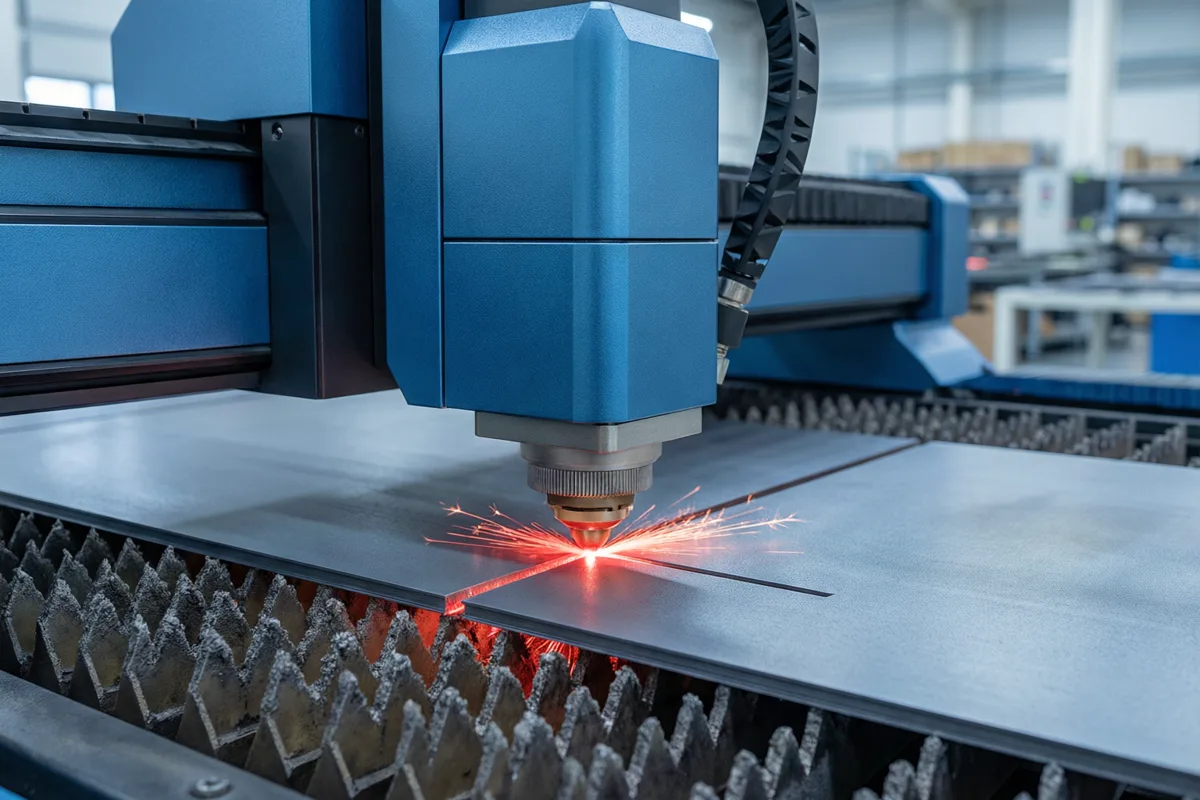
1. What Actually Determines Laser Cutting Cost: 6 Factors
Every quotation we issue breaks down into the same six variables. Understanding them lets you read any quote — and challenge the parts that look wrong.
1.1 Material type and assist gas
Mild steel is normally cut with oxygen, which adds exothermic heat and keeps prices lowest. Stainless steel and aluminum require nitrogen or compressed air to avoid oxidation on the cut edge, and high-pressure nitrogen consumption can equal or exceed the machine-time cost on thick sections. As a rule of thumb, stainless runs 1.5–2× the per-meter price of mild steel at the same thickness, and aluminum sits slightly above stainless because of its reflectivity and thermal conductivity.
1.2 Thickness
Cutting speed drops steeply as thickness rises. A modern 6 kW fiber laser traverses 3 mm mild steel in the tens of meters per minute, but slows to a few meters per minute at 10 mm and roughly one meter per minute around 20 mm. Machine time is the largest cost block in most quotes, so thickness compounds quickly — see the per-meter table in Section 2.
1.3 Cut length and part complexity
Billing per meter means geometry matters: a 300 mm square costs four cut segments, while a part with dense hole patterns and small contours adds pierce count and slow small-feature cutting. Piercing thick plate consumes time and nozzle life; hundreds of small holes can double effective cycle time versus a simple outline of the same total length.
1.4 Quantity and nesting efficiency
Batch orders spread fixed costs — programming, setup, material handling — across many parts. More importantly, tight nesting on standard sheet sizes pushes material utilization from a typical 60–65% to 80%+, which directly lowers the material share of your unit price.
1.5 Edge quality and tolerances
Standard structural quality per ISO 9013 range bands (e.g., grade 2–3 tolerances on squareness and mean height of profile)[1] comes with the base price. Demanding machined-grade tolerances, dross-free edges on thick stainless, or surface roughness guarantees slows cutting speeds 20–40% and may add secondary operations. General dimensional tolerance expectations follow ISO 2768-1 classes unless otherwise agreed[2].
1.6 Raw material market
Steel plate prices move with the mill cycle. Quotes normally lock material cost for 15–30 days; for large projects we recommend confirming the validity window before awarding. Plate flatness and thickness tolerance of the incoming stock follow ASTM A6 / EN 10029 classes[3][4], and tighter incoming tolerance costs more upstream.
2. Typical Cost Per Meter by Material and Thickness (2026)
The table below summarizes ranges from our own quotation database for batch job-work (supply of material included, standard structural edge quality, ex-works China). Treat them as planning numbers: individual quotes vary ±30% with quantity, geometry and gas arrangement.
| Nominal thickness | Mild steel (O₂) | Stainless steel (N₂) | Aluminum (N₂) |
|---|---|---|---|
| 1 mm | $0.30–0.50 /m | $0.50–0.80 /m | $0.60–0.90 /m |
| 3 mm | $0.60–1.00 /m | $1.20–2.00 /m | $1.40–2.40 /m |
| 6 mm | $1.20–2.00 /m | $2.50–4.50 /m | $3.00–5.00 /m |
| 10 mm | $2.50–4.00 /m | $5.00–9.00 /m | $6.00–10.00 /m |
| 16 mm | $5.00–8.00 /m | $10.00–18.00 /m | $12.00–20.00 /m |
| 20 mm | $8.00–14.00 /m | $16.00–28.00 /m | contact us |
Two things buyers consistently misjudge from this table. First, the jump from 6 mm to 10 mm is roughly 2× — crossing a thickness band changes the economics, not just the material volume. Second, thin stainless cut with nitrogen can cost more per meter than much thicker mild steel cut with oxygen; material choice and gas strategy interact.
3. Per-Meter vs Per-Part vs Hourly: Which Quote Should You Ask For?
| Billing basis | Best for | Risk to watch |
|---|---|---|
| Cost per meter | Long profiles, trim work, simple outlines | Ignores pierce count; dense-hole parts get repriced |
| Cost per part | Repeat production parts, brackets, plates | Requires stable drawings; revisions reset the price |
| Hourly machine rate | Prototypes, mixed unknowns, R&D batches | No efficiency incentive; audit nesting afterwards |
For procurement we recommend per-part pricing once drawings are frozen, and per-meter only for linear trim work. A typical 6–12 kW fiber laser shop in China bills machine time in the $25–60/h band depending on power, gas arrangement and order size — anything dramatically below that range usually means recycled pricing on old CO₂ equipment or excluded gas costs.
A worked example
Take a 200 × 300 mm mounting plate in 6 mm mild steel with four 12 mm holes. Outline length is 1.0 m; at the mid-range $1.60/m that is $1.60 of cutting. The four holes add pierce cycles plus roughly 0.15 m of contour. In a batch of 50 pieces the same part typically lands at $1.90–2.30 each including material, versus $4+ as a one-off. This is why consolidating quantities moves the price more than any negotiation does.
4. Laser vs Plasma vs Waterjet: Where the Money Goes
Cost comparisons only make sense at fixed thickness and quality. In our experience across thousands of jobs:
- Below 12 mm mild steel: fiber laser wins on both speed and edge quality; plasma is cheaper per meter only on very thick, low-accuracy work. Our detailed breakdown is in fiber laser vs plasma vs waterjet.
- 12–25 mm structural work: plasma competes on price where ISO 9013 grade 3–4 edge quality is acceptable; laser still wins when holes, bevels or weld-prep quality matter.
- Heat-sensitive or clad materials: waterjet avoids HAZ entirely but runs 3–5× the per-meter cost of laser on thin sheet.
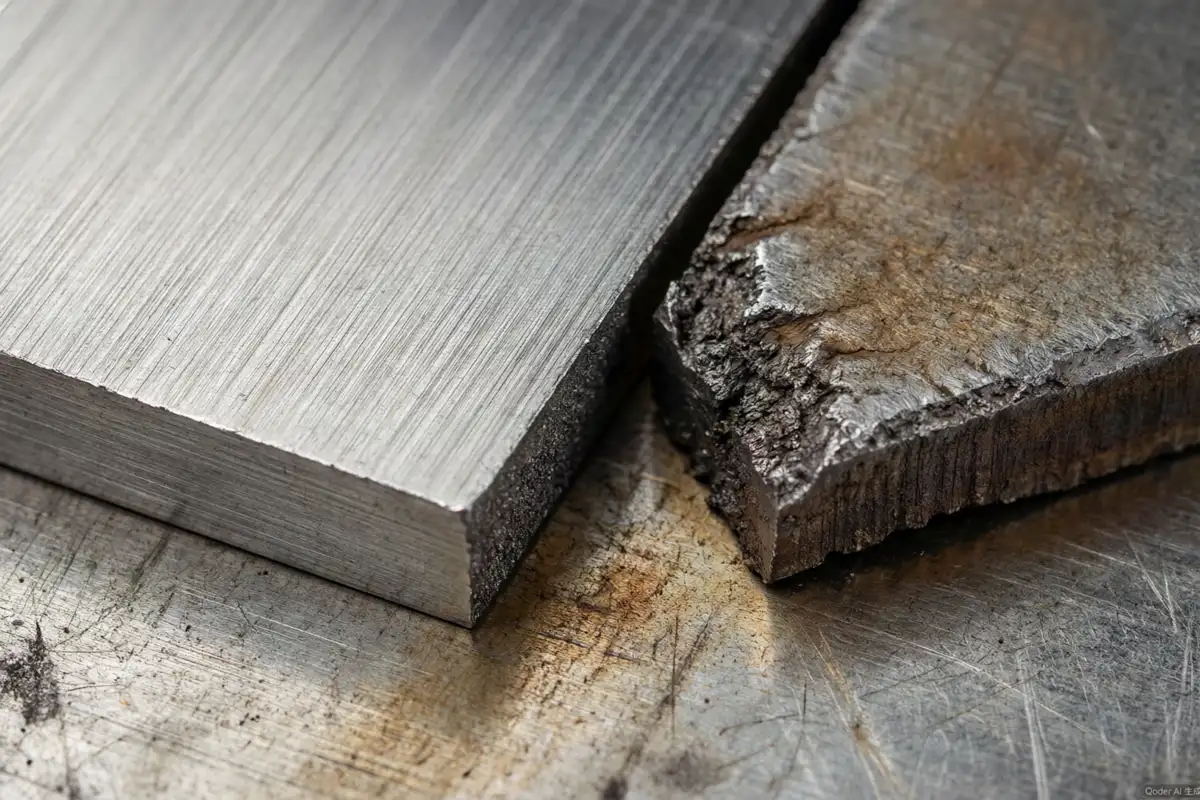
The hidden cost most quotes omit is secondary work. A plasma edge that needs grinding before welding can erase its lower cutting price; always compare finished-edge cost, not cutting cost.
Consider the same 10 mm S235JR bracket with eight holes: laser quotes around $3.10 of cutting and leaves edges ready to weld; plasma quotes around $2.20 but typically adds $1.50–2.50 of grinding per part to reach the same weld-ready condition. The cheaper cutting line produces the more expensive finished part.
5. How Thickness Changes the Economics
Thin sheet (1–6 mm) is dominated by material cost and nesting; thick plate (12 mm+) is dominated by machine time and gas. The crossover matters for design: a bracket redesigned from 16 mm to 12 mm plate can lose 30% of its cutting cost even before material savings. We cover practical cutting limits and speed expectations in how thick can a fiber laser really cut.
On perforated and patterned work, the billing basis shifts from length to pierce-heavy cycle time — see our analysis in laser vs punching for perforated panels before choosing a process for hole-dense parts.
6. Five Ways to Cut Your Laser Cutting Bill by 15–30%
- Nest across your whole order. Sending ten part files in one batch lets the nesting engine mix parts and hit 80%+ material utilization instead of 60–65% per separate sheet.
- Keep a common thickness palette. Every thickness change is a setup; consolidating 8/10/12 mm designs onto two thicknesses reduces both setups and material inventory.
- Relax tolerances where function allows. Moving from machined-grade to ISO 9013 structural grade can raise cutting speed 20–40%.
- Send clean DXF files. Broken polylines, duplicate geometry and unjoined segments create phantom cuts; a clean file per our DXF vs STEP guide avoids re-quoting.
- Order with the next batch. Consolidating monthly demand into one production run spreads fixed costs and improves nesting — most savings we deliver come from this one habit.
7. How to Read a Quote From a Chinese Supplier
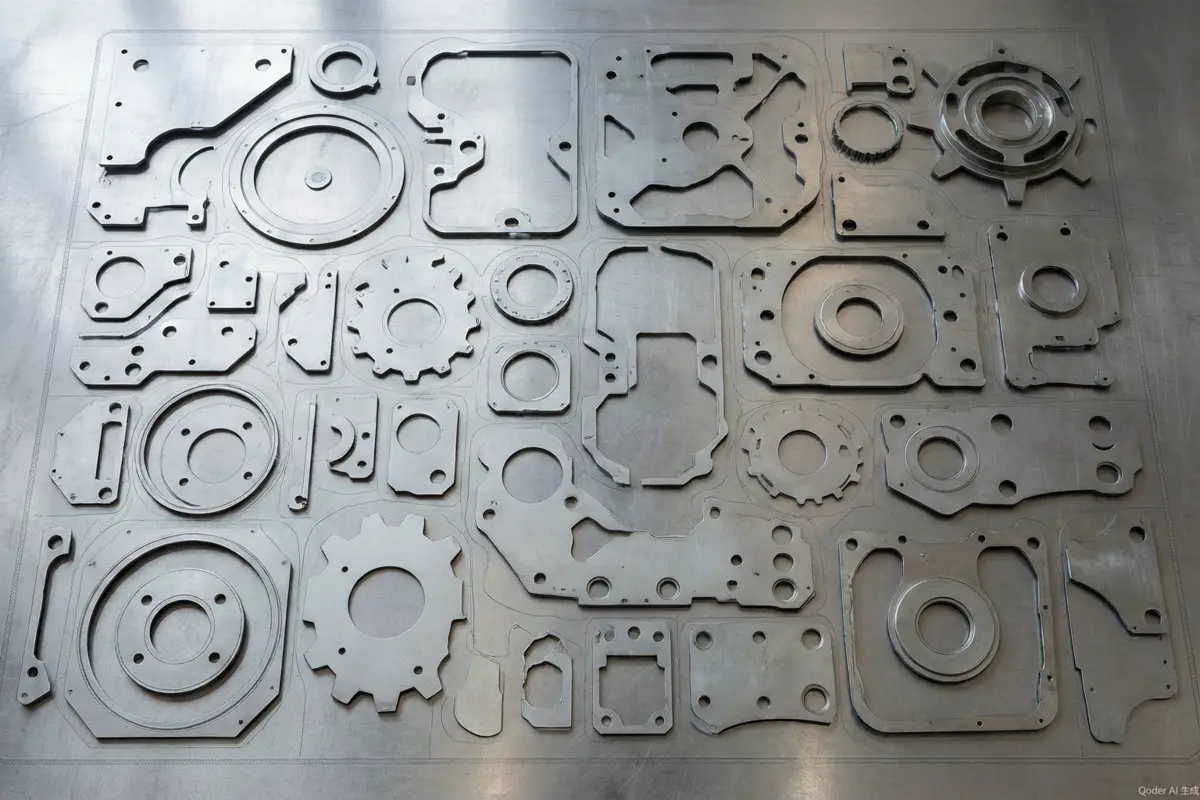
A comparable quote should separate at least these lines: material (with grade and standard, e.g. Q235B / S235JR / 304 per EN 10029)[4], cutting meters or per-part price, gas charge, setup/programming, surface treatment if any, and packing. Red flags: no validity period, no material standard named, and a single lumped number that cannot be audited. Our ordering guide for custom steel plates from China walks through the full request-to-shipment sequence.
If you are comparing suppliers, ask each to quote the same three representative parts — one thin, one thick, one hole-dense. Spread across the three reveals more than any single price.
| Quote line | What to check |
|---|---|
| Material | Grade and standard named (S235JR / Q235B / 304, per EN 10029), thickness tolerance class |
| Cutting | Per-part or per-meter basis; pierce policy for hole-dense parts |
| Gas and consumables | Included or itemised — nitrogen charges on stainless are the classic hidden line |
| Secondary work | Deburring, grinding, chamfering — priced explicitly or explicitly excluded |
| Validity | 15–30 days is normal; lock the price before award on volatile plate markets |
Three questions separate professional quotes from rough ones: What happens to unit price if my quantity doubles mid-order? Do you provide mill test certificates with the batch? How do you handle a part that fails dimensional check on arrival? Suppliers who answer all three concretely are quoting from a real cost model; suppliers who dodge them are quoting from a guess.
FAQ
How much does laser cutting cost per meter in 2026?
Typical ex-works China ranges: 3 mm mild steel $0.60–1.00/m, 6 mm $1.20–2.00/m, 10 mm $2.50–4.00/m; stainless steel costs roughly 1.5–2× the same thickness in mild steel. Quantity and geometry move individual quotes ±30%.
Is laser cutting cheaper than plasma?
Below about 12 mm, yes — laser is faster and leaves a weld-ready edge, so finished-part cost is lower. Above 20 mm where edge quality tolerances are loose, plasma can win on the cutting line but often loses after secondary grinding.
Why is stainless steel laser cutting more expensive?
Nitrogen assist gas (needed for a clean, oxidation-free edge) plus slower speeds and higher reflectivity handling make stainless roughly 1.5–2× mild steel per meter at equal thickness.
Does quantity really lower the price per part?
Yes, through two mechanisms: fixed costs (programming, setup) spread over more parts, and better nesting raises material utilization from ~60% to 80%+ across a consolidated batch.
What file format should I send for an accurate quote?
1:1 DXF for 2D profile cutting is fastest to quote; STEP adds value when bending or machining follows. Avoid PDF-only drawings for cutting quotes — they force manual redraw and add cost.
How fast is fiber laser cutting?
Order of magnitude: tens of meters per minute on 3 mm mild steel with a 6 kW source, a few meters per minute at 10 mm, and around one meter per minute near 20 mm. Speed halves or more when edge-quality requirements tighten.
What is the minimum order quantity for laser cutting?
Most shops accept single-piece prototypes, but per-part price drops sharply up to roughly 20–50 pieces as setup and nesting costs spread. Below one standard sheet, expect to pay a sheet minimum rather than strict part cost.
Do suppliers provide mill test certificates?
Reputable suppliers provide MTRs (EN 10204 3.1-type certificates) on request, usually free for full-batch orders or at small extra cost for split batches. Ask before awarding the order, not after delivery.
Want an auditable quote? Send your DXF/STEP files and quantities through our instant quote form — you get a line-item quotation (material, meters, gas, setup) within 24 hours, mill test certificates available on request, and sample parts before any bulk commitment.
References
- ISO. “ISO 9013:2017 Thermal cutting — Classification of thermal cuts — Geometrical product specification and quality tolerances.” ISO, 2017. iso.org/obp (ISO 9013) (accessed Aug 29, 2026).
- ISO. “ISO 2768-1:1989 General tolerances — Part 1: Tolerances for linear and angular dimensions without individual tolerance indications.” ISO, 1989. iso.org/obp (ISO 2768-1) (accessed Aug 29, 2026).
- ASTM International. “ASTM A6/A6M Standard Specification for General Requirements for Rolled Structural Steel Bars, Plates, Shapes, and Sheet Piling.” ASTM, current edition. astm.org/a0006_a0006m-26 (accessed Aug 29, 2026).
- CEN. “EN 10029:2010 Hot rolled steel plates 3 mm thick or above — Tolerances on dimensions and shape.” CEN, 2010. (purchased standard; no free public page — verify by standard number)
- Zemlaser. Internal quotation database, batch job-work pricing, accessed Aug 28, 2026.(第一手报价数据,本网站)