TL;DR: Bevel laser cutting tilts the cutting head (or the sheet) so the laser cuts weld preparation — V, X, K and Y grooves with root faces — in the same pass as the part contour. One setup replaces cut-then-bevel with a mill, grinder or flame torch: less handling, tighter angles, and edges that go straight to welding. This guide explains how bevel laser cutting works, what bevel types and materials it handles, what your drawings must specify, and when outsourcing bevel-ready parts beats buying the head.
1. What Bevel Laser Cutting Is — and What Problem It Deletes
Any welded structure thicker than a few millimetres needs prepared edges: a groove that lets the weld penetrate the full joint. Traditionally that preparation is a second operation — the plate gets cut square, then moved to a milling machine, an edge beveller, or an angle grinder to have the groove added. Every one of those routes costs handling time, a second setup, a second tolerance stack, and often a heat-affected or mechanically roughened edge.
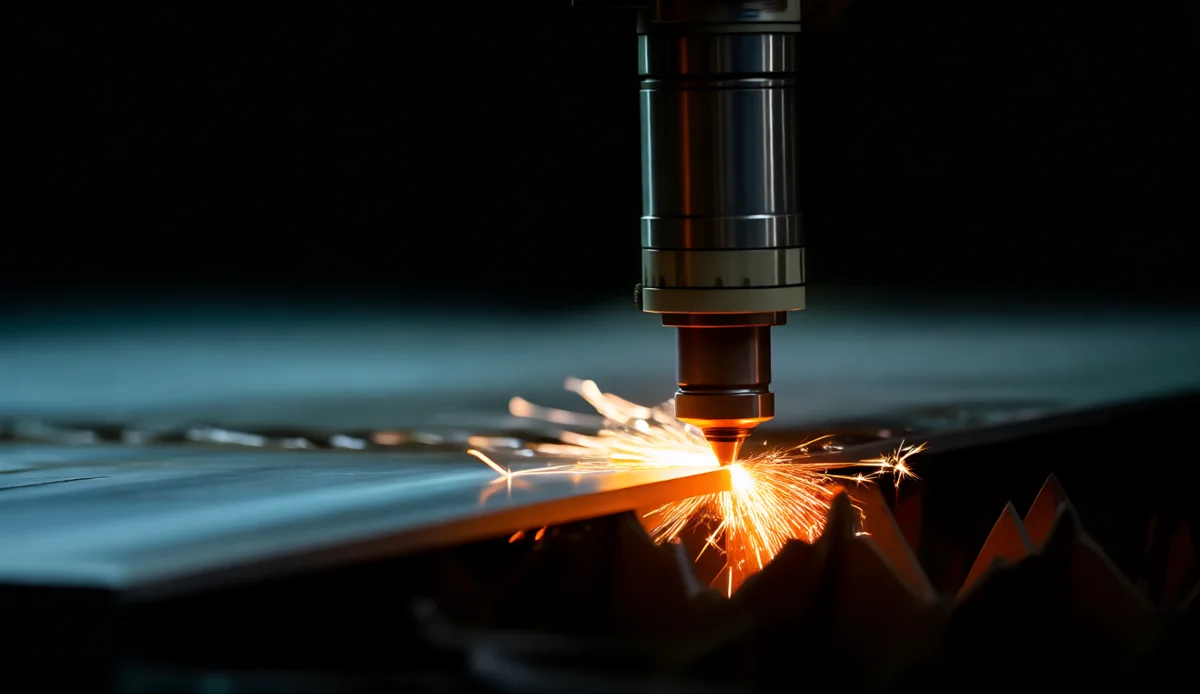
Bevel laser cutting removes that second operation. A bevel-capable fiber laser carries either a swivelling cutting head or a tilting table that angles the beam away from vertical — typically ±30° to ±45° — and cuts the groove face directly into the part contour in one pass. The part comes off the machine with weld prep already done, dimensionally repeatable, and ready for the welding cell.
The economics are why this technology spread fast in European structural steel, pressure vessel, and shipbuilding supply chains, where weld preparation to EN ISO 9692-1 is standard practice and every skipped secondary operation lands directly in the fabrication cost.
2. How the Machines Do It: Head Tilt, Table Tilt, and Tube Axes
There are three main implementations, and they determine what you can order:
- Swivel head (A/B or 5-axis head). The cutting head tilts around two rotational axes while the sheet stays flat. Most common on modern flatbed machines; cuts contours and bevels in one program. The head dynamics limit how aggressive the tilt can be at high speed, so bevel sections run slower than square cuts.
- Tilting table or table-segment tilt. The sheet (or a section of the table) tilts under a vertical head. Handles heavy plate well, but tilt mass limits dynamics; common on very thick-section machines.
- 3D tube lasers. On tube machines the chuck rotates and the head pitches/yaws, cutting bevelled ends and saddle-notched intersections on round, square, and rectangular tube. This is the workhorse for space frames, handrails, and structural nodes where tube-to-tube joints need prep.
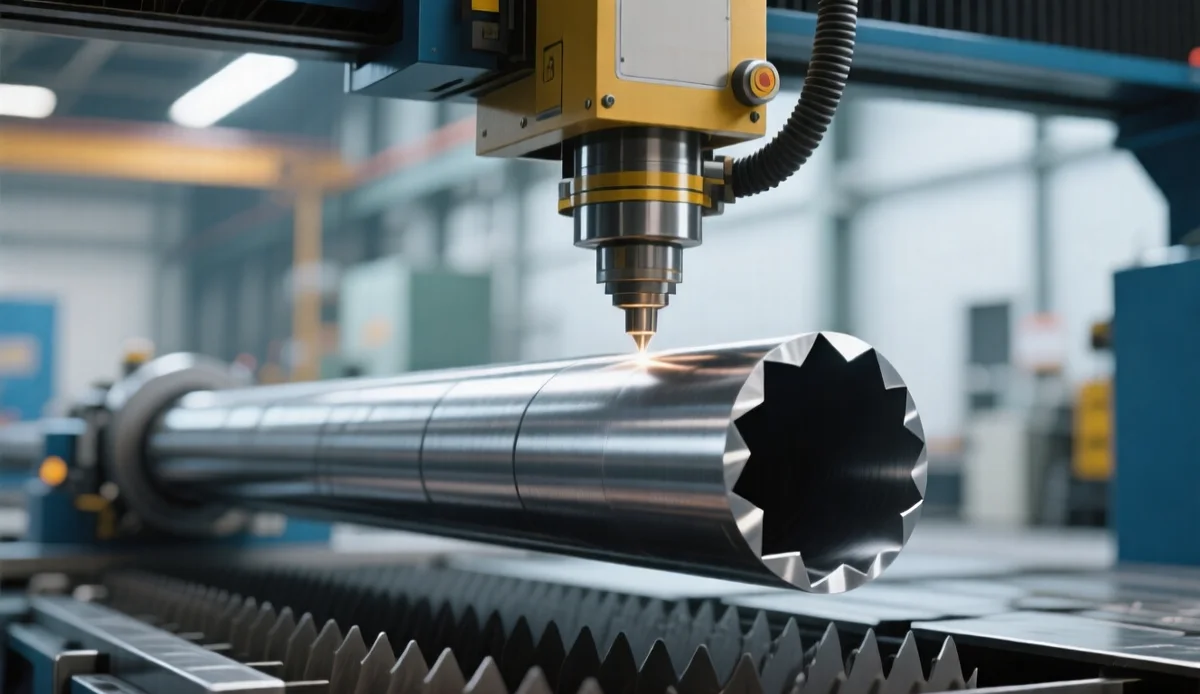
Practical consequence for buyers: a “bevel laser cutting” capability listing should say which type, because a swivel-head flatbed won’t do your tube joints and a tube laser won’t bevel plate parts. Angle capability is quoted per machine — commonly ±30°, ±45°, or in some configurations more on one axis.
3. Bevel Types the Laser Can Cut
| Groove type | Cut by bevel laser? | Typical use |
|---|---|---|
| V (single bevel) | Yes — one tilted pass | Butt joints up to ~12–15 mm, one-side welding |
| X (double V) | Yes — two passes or cut-through tilt | Thick plate, balanced distortion, both-side welds |
| K / single-bevel (T-joints) | Yes | Fillet-backed joints, stiffeners, frames |
| Y / half-V variants | Yes | Asymmetric joint designs |
| U groove | Generally no — needs milling | Very thick section, narrow included angle |
| Compound / J prep | Limited — radius faces need milling | Critical thick-wall pressure joints |
The laser cuts straight faces, so any groove whose walls are planar is in scope; curved-face preps (U, J) remain milling territory. Included angles of 30–60° cover the majority of joint designs, with root face held to roughly ±0.5 mm and bevel angle to about ±1° on a well-tuned machine — tighter than manual grinding and comparable to dedicated bevelling machines. Edge face quality of the bevel itself follows the same thermal-cutting classes as square cuts; ISO 9013 is the shared vocabulary for specifying it, exactly as covered in our tolerances guide.
4. One Pass vs Secondary Bevelling: The Real Comparison
| Route | Setups | Angle/root-face control | Speed (per joint metre) | Typical cost driver |
|---|---|---|---|---|
| Bevel laser cutting | 1 | ±1° / ±0.5 mm, repeatable | Fastest overall | Machine premium, amortized |
| Mill / edge beveller | 2 | Good, mechanical | Slow — second handling | Labour + second machine time |
| Angle grinder (manual) | 2 | Poor, operator-dependent | Slowest | Labour; quality risk |
| Flame / plasma bevel | 2 | Moderate | Moderate | Extra heat input + cleanup |
The comparison most shops undercount is handling, not cutting: a plate that must move from the laser to a beveller and back (or to the weld table with prep added there) costs crane time, queue time, and a second inspection. On batch work with many welded joints, one-pass bevel cutting typically wins even when its machine hour costs more.
5. Materials and Thickness Sweet Spot
Bevel cutting concentrates where thick welded joints live:
- Mild/structural steel, roughly 6–25 mm — the sweet spot. Below ~6 mm weld prep is often unnecessary (full-penetration fillets); above ~25 mm X-preps and U-grooves push toward milling or dedicated thick-bevel heads.
- Stainless steel to ~15–20 mm — bevels cut with nitrogen for oxide-free weld-ready faces; the gas choice matters even more on bevel faces because the weld reads the edge chemistry directly (see our assist gas guide).
- Aluminum — bevelable, but high reflectivity plus tilt dynamics narrow the window; edge quality on bevel faces needs verification cuts first.
- Tube and profiles — 3D tube lasers bevel ends and cut intersecting saddles on structural tube up to typical wall thicknesses of 12–15 mm, which is why bicycle, furniture, and structural-node fabrication adopted it early.
Speed and power behave as in square cutting — our thickness and speed charts give the baseline; expect bevel passes to run at a fraction of square-cut speed because the tilted beam travels a longer path through the material and the head dynamics are slower.
6. What Your Drawing Must Specify
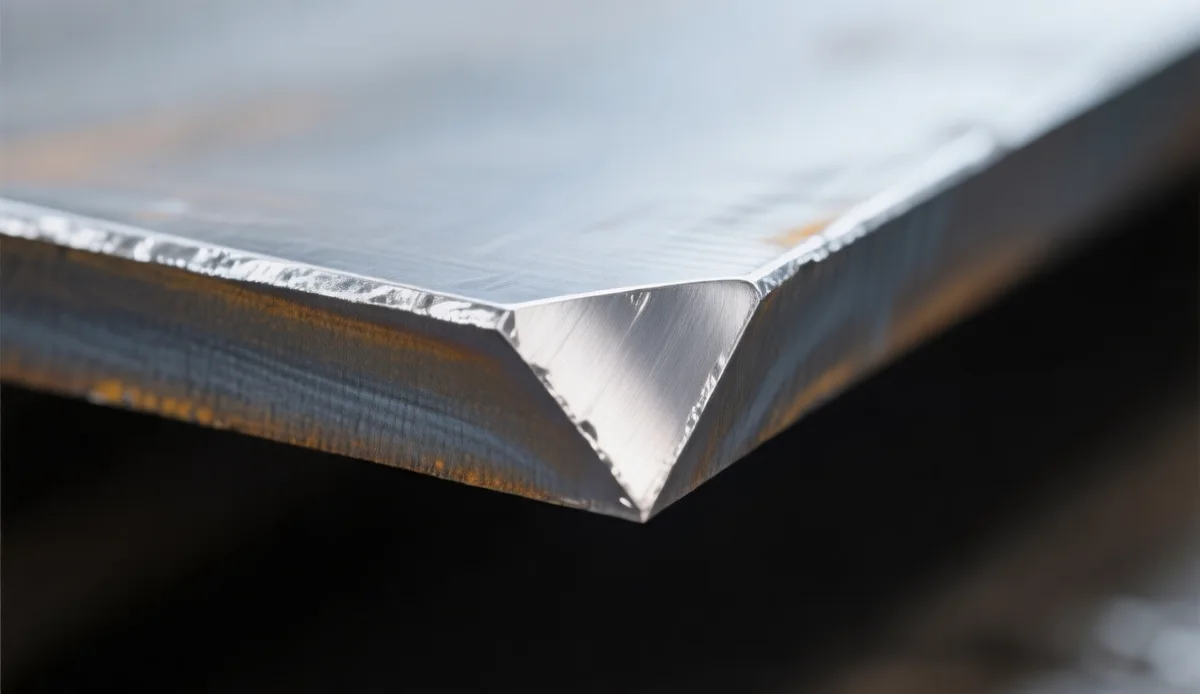
Bevel cutting fails commercially more often on drawings than on machines. A bevel-ready order needs:
- Groove type and dimensions — bevel angle (or included angle), root face height, and root gap intent. Standard joint designs are catalogued in EN ISO 9692-1 (Europe) and the corresponding AWS documents; use the AWS welding symbol conventions or ISO 2553 symbols on the drawing so both sides read the same joint.
- Which edges get prep — mark bevelled contours explicitly. A common ordering error is assuming every weld joint gets a bevel; the shop should not guess.
- Welding side / process context — one-side or two-side welding changes V vs X; MIG/MAG vs submerged-arc changes root face tolerance expectations.
- Compensation expectations — the tilted cut consumes slightly more material along the bevel (kerf geometry); on parts where the finished dimension matters post-weld, state whether the given dimension is pre- or post-bevel.
Send that on the DXF/STEP plus a marked drawing, and the quote you get back will be firm instead of conditional — the same RFQ discipline our sourcing guide describes applies directly to bevel orders.
7. Buy the Bevel Head or Order Bevel-Ready Parts?
For fabricators, the honest decision table:
- Buy / retrofit when bevelled joints are a large share of your weekly volume, your parts repeat enough to amortize programming, and you have the weld-cell layout to consume prepped parts immediately. The head carries a real premium on the machine price and slows square-cut duty cycles when shared.
- Outsource bevel-ready blanks when weld prep is occasional, when thick plate handling is your bottleneck anyway, or when you want prep quality without capital. You pay a premium per metre on the bevelled contour — our cost per meter guide shows how per-metre pricing extends to bevelled paths — but you skip the capital, the slow head sharing, and the second-operation queue.
- Mixed is common: outsource thick X-prep blanks, bevel routine V-preps in house.
For buyers who don’t run lasers at all, the conclusion is simpler: ordering parts with weld prep already cut removes a whole operation from your weld shop, and the per-part price difference is usually smaller than the fabrication time it saves.
8. Where Bevel-Cut Parts Go
- Structural steel and construction nodes — beam stub plates, gussets, and base plates with K/V preps going straight to site welding.
- Pressure vessels and thick-wall fabrication — X-preps on shell courses and nozzle reinforcement plates, where consistent root faces matter for weld quality and code inspection.
- Shipbuilding and offshore — panel edges and profile ends prepared in bulk; this sector drove much of the technology’s adoption.
- Tube structures — frames, handrails, masts: bevelled tube ends and saddle cuts that fit without gap-filling.
- Machine bases and heavy equipment — weldments whose joints are few but thick enough to demand proper prep.
9. Common Misconceptions
“Any laser can cut bevels if you tilt the sheet.” Physically you can angle material under a standard head, but you lose contour accuracy, focus position control, and nozzle-to-sheet clearance across the tilt. Real bevel laser cutting means a machine designed to hold precision while the beam path tilts.
“Bevel cutting is slower, so it costs more.” Per metre, the bevel pass is slower — but the comparison that decides money is one setup versus two, and handling is where multi-setup routes lose. Measure total cost per prepared joint, not per cut metre.
“The welder can fix bad prep at the table.” Grinders do get used — and that is exactly the labour cost and quality variance bevel cutting exists to delete. Prep done at the laser is repeatable; prep improvised at the weld table is not.
“Bevels are only for very thick plate.” The sweet spot starts around 6 mm where single-V prep matters, and tube joints need prep at far thinner walls. The question is joint design, not just thickness.
Frequently Asked Questions
What is bevel laser cutting?
Cutting weld-preparation grooves (V, X, K, Y) with a fiber laser whose head or table tilts — typically ±30° to ±45° — so the angled edge is cut in the same pass as the part contour. It replaces secondary bevelling with a mill, grinder, or flame torch.
What angles can a bevel laser cut?
Commonly ±30° to ±45° from vertical depending on the head configuration, with bevel angle repeatability around ±1° and root face control near ±0.5 mm. Exact capability is machine-specific — ask for the tilt range and check it against your joint design.
Which materials can be bevel laser cut?
Mild and structural steel roughly 6–25 mm is the sweet spot; stainless to ~15–20 mm with nitrogen; aluminum is possible but needs verification cuts; tube walls to ~12–15 mm on 3D tube lasers. U and J grooves with curved faces remain milling work.
Is bevel laser cutting cheaper than milling the bevel?
On total cost per prepared joint, usually yes: one setup, no second handling, and repeatable geometry. The machine hour is pricier than a plain laser pass, but the saved second operation and queue time normally outweigh it on batch welded work.
What do I need on my drawing for a bevel order?
Groove type, bevel angle, root face, root gap intent, and which edges get prep — marked with standard welding symbols (ISO 2553 / AWS). State whether dimensions are pre- or post-bevel where the finished size matters.
Can tube be bevel laser cut?
Yes — 3D tube lasers rotate the tube while the head pitches and yaws, cutting bevelled ends and saddle intersections on round, square, and rectangular sections. It is standard practice for frames, handrails, and structural nodes.
Does the bevel face quality suit welding directly?
Yes when cut with the right gas: nitrogen bevel faces on stainless and aluminum are oxide-free and weld-ready; oxygen-cut bevel faces on mild steel carry an oxide layer that routine structural welding accepts, with grinding specified only for critical or coated work.
Should I buy a bevel head or order bevel-ready parts?
Buy when bevelled joints dominate your weekly volume and parts repeat; outsource when prep is occasional or thick-plate handling is already your bottleneck. Many shops run mixed: outsourced thick X-preps, in-house routine V-preps.
Conclusion: Prep at the Laser, Not at the Weld Table
Bevel laser cutting collapses two operations into one and puts weld preparation under CNC control — the angle you drew is the angle that arrives. For structural steel, pressure vessels, shipbuilding, and tube fabrication, that repeatability is worth more than the machine premium, and for everyone else, ordering bevel-ready blanks captures the same benefit without capital. The two things that decide success are simple: a drawing that specifies the groove properly, and a supplier whose tilt range, gas practice, and edge-class commitments are on record. Send your joint details with the files through our quote page and we will confirm bevel capability, angles, and lead time before you commit.
References: ISO 9013:2017 — Thermal cutting: classification of thermal cuts, geometric tolerancing (ISO). 1 AWS — welding symbols and joint representation (aws.org). 2 EN ISO 9692-1 — Welding and allied processes: recommendation for weld joint preparation, steel (standard reference, text only). 3