TL;DR: Shearing is the cheapest way to make a straight cut in sheet metal — one blade pass, no heat, seconds per cut. Laser cutting costs more per edge but delivers any contour, clean burr-light edges, and no secondary deburring. The shearing vs laser cutting decision usually comes down to shape complexity and what the edge has to survive afterwards: a sheared edge carries a burr that cuts hands, needs grinding for coating or precision fits, and twists slightly; a laser edge comes off the table finished. Below 3 mm on long straight blanks, shearing often wins; anything contoured, thick, or handling-sensitive goes to the laser.
1. How Shearing Actually Cuts — and Why the Edge Looks the Way It Does
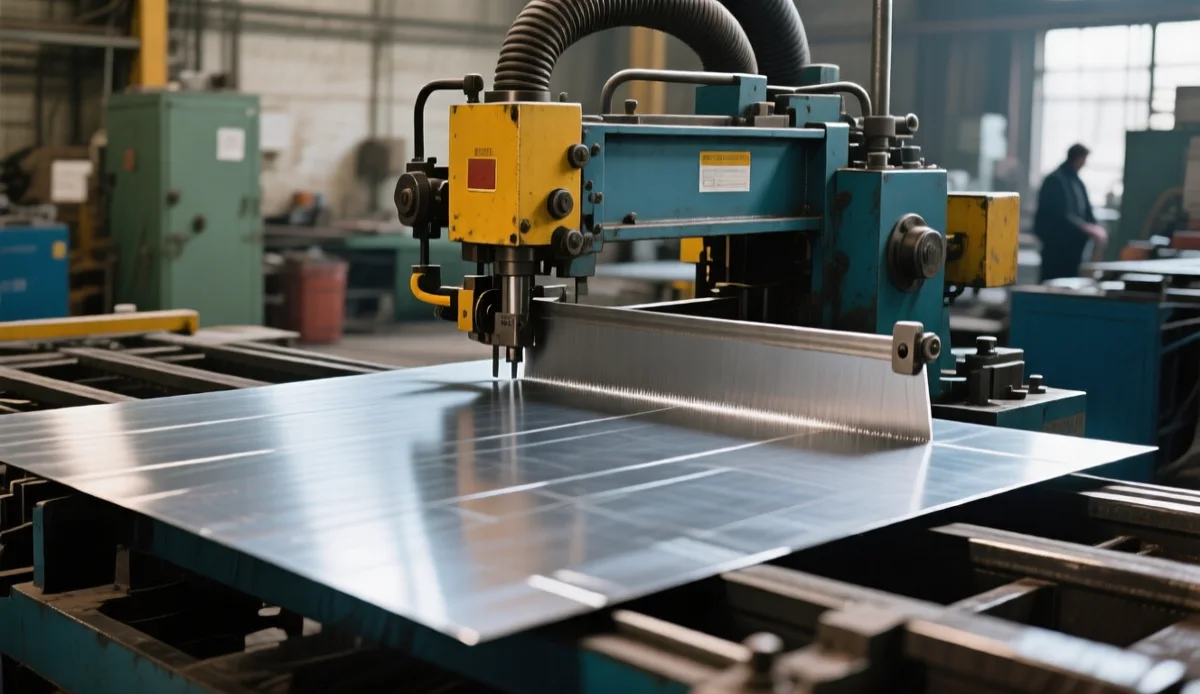
A guillotine shear (裁板机 in Chinese shops) drives an upper blade past a lower one with a small, deliberate clearance — typically 5–10% of sheet thickness. The material doesn’t slice cleanly like paper; it deforms and tears in a predictable sequence that leaves four zones on every sheared edge:
- Rollover — the top of the edge bends over as the blade first bites (rounded, work-hardened).
- Burnished zone — a smooth, shiny band where the blade slides against the material.
- Fracture zone — rough, torn surface where the material actually separates; angled by the clearance.
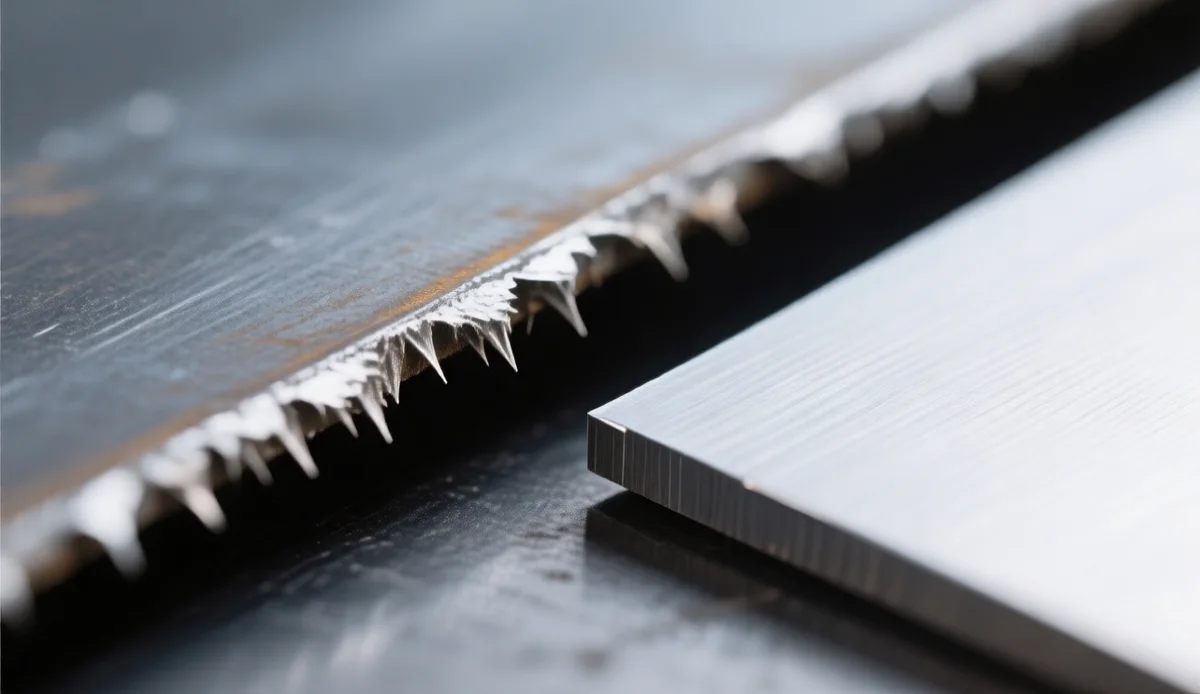
- Burr — a raised lip of displaced metal at the exit side. This is the zone that cuts hands, snags gloves, and ruins paint adhesion.
Shears themselves come in variants — guillotine (straight blade, the classic plate shear), swing-beam (arc-cutting blade on lighter machines), and corner/notch shears for trimming — but all share the clearance-and-tear physics. What separates shops is maintenance: blade sharpness, clearance set correctly per gauge, and hold-down pressure that stops the sheet shifting mid-cut. A well-kept shear leaves a modest burr; a neglected one leaves a hazard.
Every sheared part carries all four zones. The burr grows with blade wear and clearance drift — a shear with tired blades leaves heavier, sharper burrs, which is why sheared-edge quality varies from shop to shop. On long cuts, the sheet also twists and cambers slightly under the blade’s raking angle, so sheared blanks are rarely perfectly square without secondary trims.
2. What Laser Cutting Does Differently
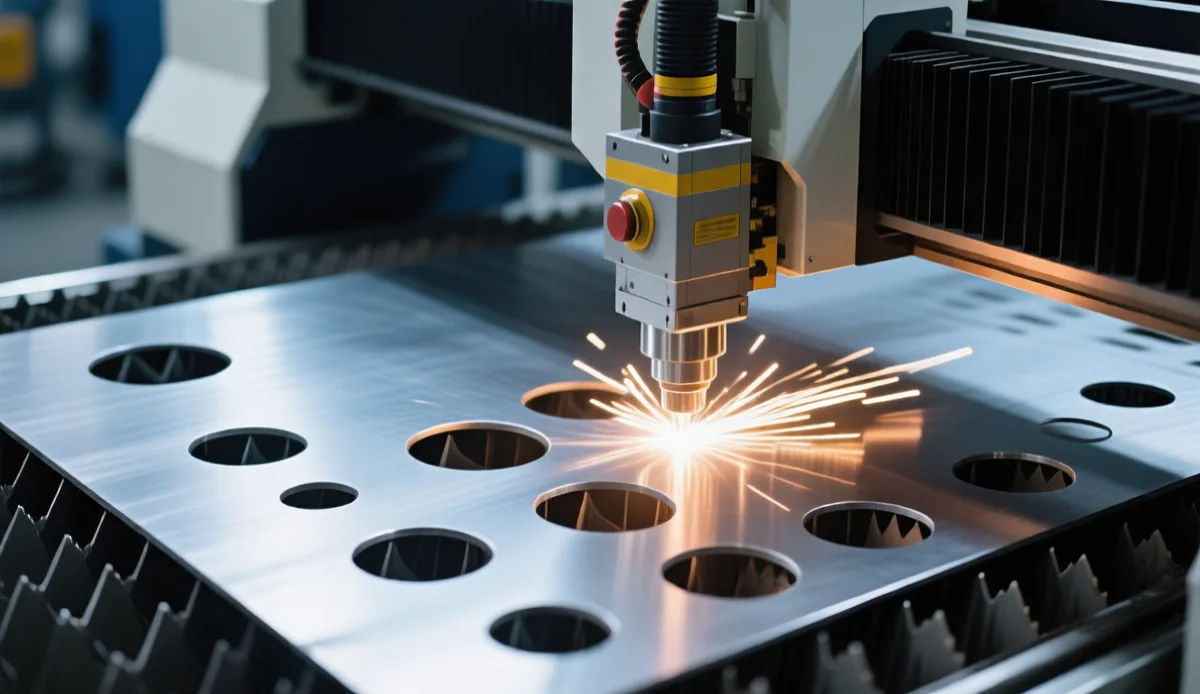
A fiber laser vaporizes and ejects material along a programmed path with a focused beam and an assist gas jet — no blade, no mechanical contact, no clearance geometry. The consequences are structural, not just cosmetic:
- Any contour, one setup. Curves, holes, slots, notches, engraved markings — all in the same program. Shearing is straight lines only; every notch or hole needs extra hits, tools, or a second machine.
- Edge quality by gas. Nitrogen-cut edges are bright and nearly burr-free; oxygen edges are cleaner than sheared fracture zones but carry oxide. Edge classes are specifiable under ISO 9013 — something shearing has no equivalent vocabulary for. Our assist gas guide covers the trade.
- Accuracy. ±0.1 mm positioning and ~0.1–0.2 mm kerf; no blade deflection, no twist, no camber. Tolerance expectations in detail: our tolerances guide.
- Heat input. The one thing shearing does that a laser cannot: cut cold. On material that must not see heat at all — certain hardened tempers or very thin decorative work — shearing keeps its niche.
3. Edge Quality Compared — The Numbers Buyers Should Ask For
Every shearing vs laser cutting comparison ends at the edge — this is the table to quote from.
| Property | Sheared edge | Laser edge (N₂) |
|---|---|---|
| Burr height | Visible lip, grows with blade wear; cuts skin easily | Minimal; dross-free with correct parameters |
| Edge squareness | Fracture angle from clearance (a few degrees) | Vertical within ~0.1 mm over thickness |
| Surface roughness | Mixed: smooth burnish + torn fracture | Even, fine striations |
| Dimensional hold | Twist/camber on long cuts | ±0.1 mm, no distortion from tool force |
| Work hardening at edge | Yes — rollover zone hardens, can crack on later bending | Heat-affected zone instead; bending lines should avoid it |
| Coating readiness | Needs deburring/edge prep or paint peels | Weld- and coat-ready as cut |
Two rows deserve emphasis. The work-hardened rollover is a silent failure source: when a sheared edge is later bent, cracks start at the hardened burr line — laser cutting removes that risk for formed parts. And the coating readiness row is pure money: powder coat over an unground sheared burr lifts and rusts along the edge, so shops that skip deburring pay for it in warranty claims.
4. The Burr Problem: Safety, Labour, and Downstream Cost
Ask any sheet metal shop what shearing really costs and the answer hides in the secondary operations. A sheared blank is not finished:
- Deburring labour. Every handled edge is ground, filed, or vibratory-finished. On a part with 4 metres of sheared edge, deburring can rival the cutting time itself.
- Handling safety. Fresh sheared edges are sharp enough to cut through gloves — one of the most common shop-floor injuries. Deburred or laser-cut parts are simply safer to move, stack, and assemble, which shows up in insurance and incident reports.
- Fit-up quality. Burr and twist propagate into assemblies: gaps in weldments, misaligned holes, cosmetic misfits. Laser parts arrive interchangeable; sheared parts often need persuasion.
Scrap and rework deserve their own line: sheared blanks that come out twisted or out of square become weldment fit-up problems three operations later, when the fix costs ten times what a corrected cut would have. Laser nesting software also squeezes more parts per sheet than straight-line blanking typically achieves, so material yield often moves with the process choice too.
This is the practical case our own production data supports: parts that go straight from cutting to welding or coating come out cheaper on the laser despite the higher cutting rate, because the shear route quietly re-bills the labour downstream. The per-metre structure of laser pricing is in our cost per meter guide — compare it against shear-plus-deburr-plus-scrap, not shear alone.
5. Cost and Speed: Where Each Wins
| Scenario | Cheaper/faster | Why |
|---|---|---|
| Long straight blanks, thin gauge (<3 mm), high volume | Shearing | Seconds per cut, no gas, no programming per part |
| Simple rectangles, no edge-quality demands | Shearing | Minimal setup; laser adds kerf loss and gas |
| Contours, holes, notches in one part | Laser | Shear + notch + drill = three setups vs one |
| Small batches / prototypes | Laser | No tooling; program changes are free |
| Thick plate (>6 mm) | Laser (or sawing) | Shears lose accuracy and edge quality with thickness |
| Parts going to coating or precision welding | Laser | Edge finished as-cut; deburring cost vanishes |
Run the arithmetic on your own part to see how fast the answer flips. A 2 mm mild steel bracket with a 1.8 m cut contour: shearing the blank is cents, but deburring four edges and truing up two holes adds minutes of labour per piece — at batch volume that labour exceeds the laser’s per-metre premium several times over. Do the same part as a plain 1 m rectangle with no downstream edge demands and the shear wins just as clearly. The crossover point lives in your part geometry and your labour rate, not in the machine brochures.
6. Decision Framework
Three questions settle most shearing vs laser cutting decisions:
- Is every cut a long straight line? If yes and the gauge is thin, shearing is legitimately cheaper. The moment a curve, hole, or notch appears, the laser takes over — the shear cannot make those without secondary work.
- What touches the edge next? Welding, coating, bending, or human hands all want a finished edge. If the next step is sensitive, pay for it at the cutting stage.
- What volume and variety? High volume of one simple blank favours shearing; mixed, changing geometry favours the laser’s zero-tooling flexibility.
Many efficient shops run both in sequence: shear coil or plate into square blanks cheaply, then laser the blanks to final contour. Each machine does what it is cheapest at — the hybrid is often the lowest total cost of all, and it is how a lot of cut-to-size plate orders are actually produced.
7. Common Misconceptions
“Shearing is always cheaper.” Per cut edge, often; per finished part, frequently not. Deburring, scrap, fit-up rework, and handling injuries are real costs that shear quotes leave out. Compare total landed cost of a finished part.
“A shear makes a clean edge if the blades are new.” New blades minimize burr but cannot change the physics: clearance-based cutting always leaves rollover, fracture angle, and some burr. Cleanliness is a laser property, not a blade property.
“Laser can’t do what a shear does fast.” On a 1,000-piece run of identical 1 m straight blanks in 1 mm, a shear is genuinely faster and cheaper — concede that case. The laser’s win starts with geometry, thickness, edge requirements, or variety.
“Laser’s heat ruins everything.” The heat-affected zone is small on modern fiber lasers, and for most structural and formed parts it is irrelevant. Where it matters (critical bend lines, hardened tempers), the fix is nesting strategy or the shear for that specific blank — not abandoning laser overall. Our laser vs punching comparison deals with the same heat question on dense hole patterns.
“Both leave the same edge if you deburr after shearing.” Deburring removes the burr, not the fracture angle, rollover, work-hardened zone, or twist. A deburred sheared edge is safer and coatable, but it is still not a laser edge — formed parts and precision fits know the difference.
Frequently Asked Questions
What is the difference between shearing and laser cutting?
Shearing cuts with blades and clearance — straight lines only, fast and cheap, but it leaves a burr, fracture angle, and twist. Laser cutting follows any programmed contour with a focused beam, delivering clean, accurate, weld-ready edges at a higher per-metre cost.
Is shearing cheaper than laser cutting?
For long straight cuts in thin sheet, yes per edge. For finished parts, often no — sheared parts usually need deburring and generate more fit-up rework. Compare total cost including secondary operations.
Do sheared edges need deburring?
Almost always, if the part will be handled, coated, or precision-fitted. The sheared burr is sharp, inconsistent, and lifts coatings. That labour is the hidden line in shear pricing.
Which gives better accuracy?
Laser: ±0.1 mm with no tool deflection or material twist. Shearing accuracy degrades with blade wear, clearance, and cut length — long sheared blanks camber and go out of square.
Can shearing cut thick plate?
Heavy shears cut substantial thickness, but edge quality and squareness fall off, and the tonnage needed grows fast. Above roughly 6 mm, laser (or sawing for pure straight cuts) usually delivers better value.
Is laser cutting safer for workers than sheared parts?
The parts are: laser-cut edges are burr-light and safe to handle, while fresh sheared edges cut through gloves and drive deburring work. That handling difference shows up in shop injury statistics.
When should I choose shearing over laser?
Thin gauge, very long straight cuts, high volume of one simple blank, or material that must stay cold-cut. Everything with contours, holes, thick sections, or edge-quality demands goes to the laser.
Can a shop use both processes on one order?
Yes — and often should. Shearing square blanks from coil or plate is the cheapest first step; laser profiling the blanks to final contour is the cheapest second step. The hybrid minimizes total cost.
Conclusion: Buy the Edge You Actually Need
Shearing vs laser cutting is not a technology debate; it is an edge-economics question. If your part is a thin, straight, high-volume blank with no downstream sensitivity, shear it. If it has any geometry, any thickness, or any next step that touches the edge — welding, coating, bending, human hands — the laser’s finished edge is cheaper than the shear’s bargain edge plus everything the burr costs later. Specify the edge requirement on the drawing, quote both routes with secondary operations included, and the answer writes itself. If you want both numbers on your actual parts, send the files through our quote page — we cut both ways and will tell you which one your part should use.
References: ISO 9013:2017 — Thermal cutting: classification and geometric tolerancing of cut edges (ISO). 1 British Stainless Steel Association — fabrication and edge-quality advisory material (bssa.org.uk). 2