Quick answer: Prefab steel structure components arrive on site as three families — primary structural members (beams, columns, braces), connection elements (gusset plates, connection plates, base plates), and cast-in elements (embed plates, anchor channels). Laser cutting earns its place on the connection and cast-in families, where plate geometry is complex, tolerances are tight, and hole patterns must match bolts and anchors exactly. Buy the standard profiles from a mill or steel service center; laser-cut everything with a plate-shaped footprint.
This page is the map: what prefab steel components exist, which ones make sense to laser cut, which standards govern their tolerances, and how to source them from China without certification or packing surprises. For the deep dives, we link our dedicated guides for gusset plates, connection plates, and precast moulds further down.
What Counts as a Prefab Steel Structure Component
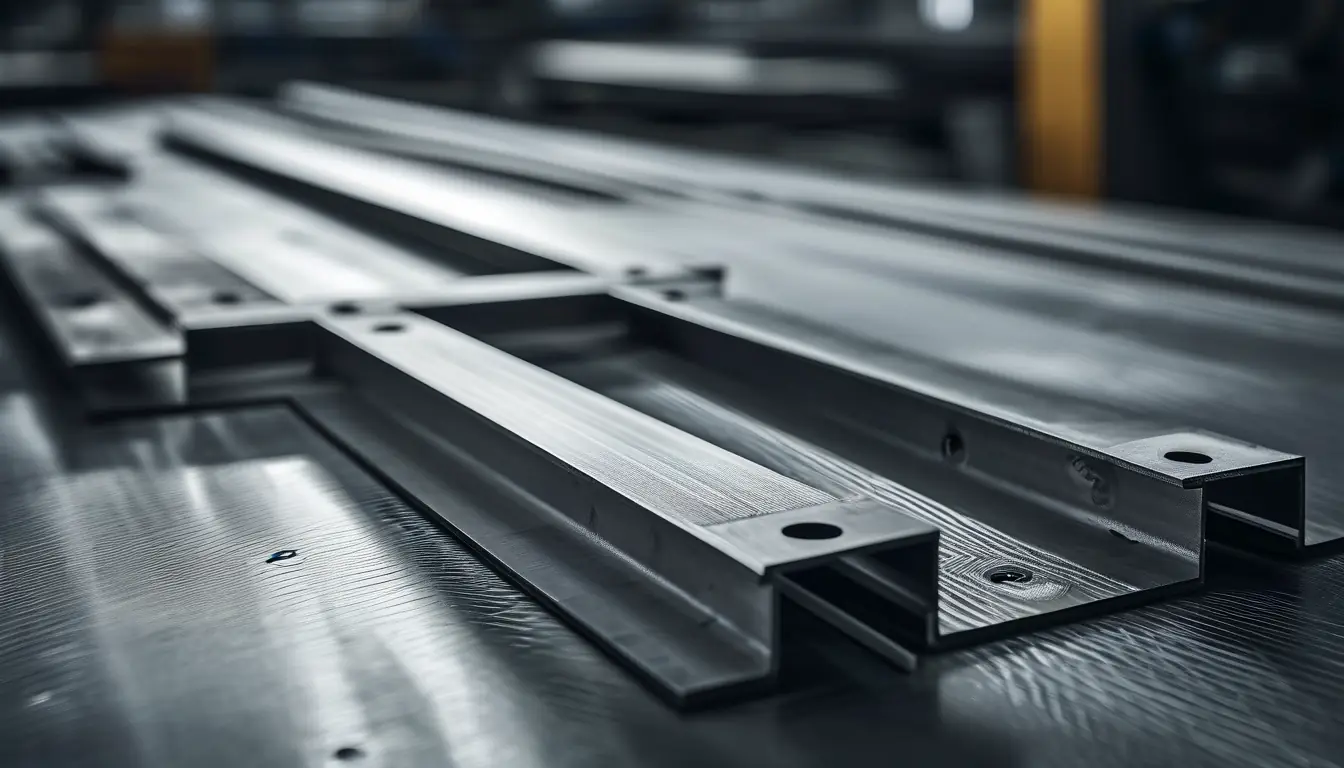
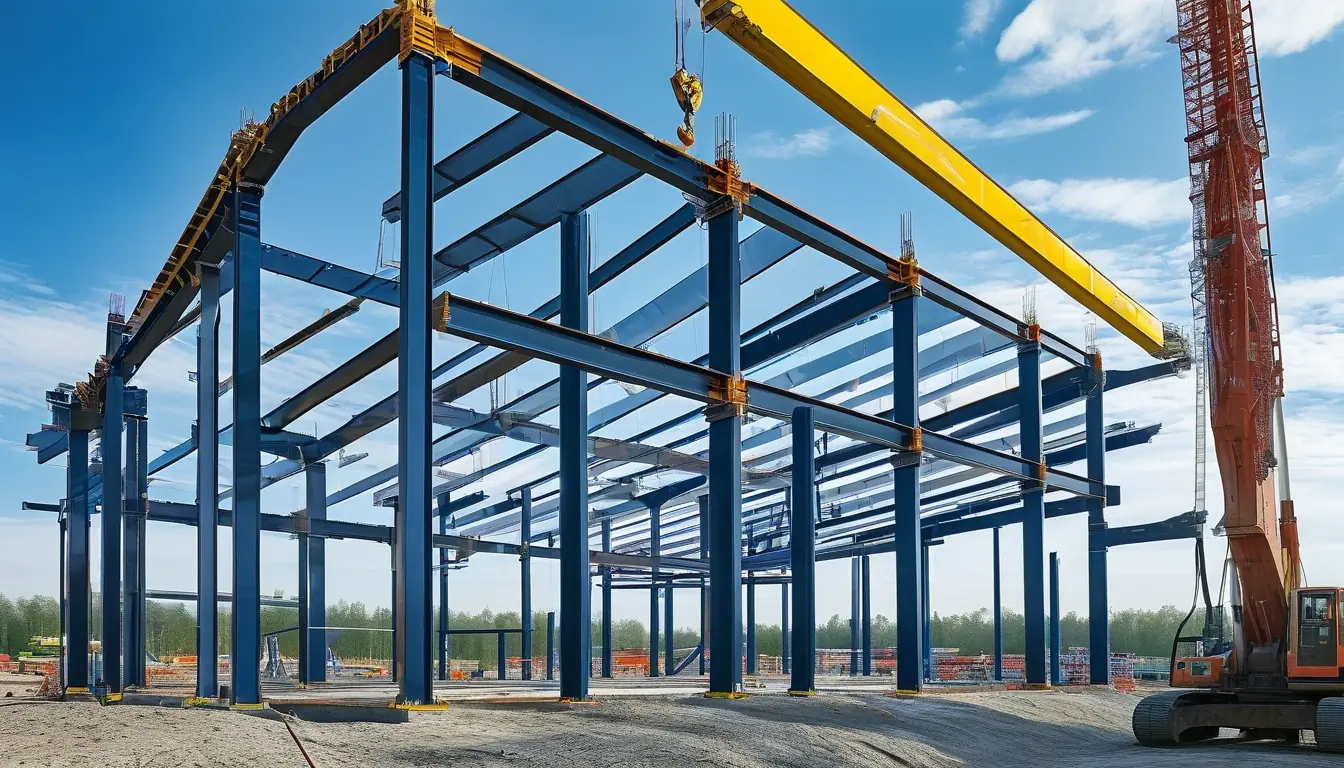
Prefabricated (prefab) steel construction means the structure is manufactured off-site and bolted or welded together on site. McKinsey’s work on modular and off-site construction identifies it as one of the few levers that reliably raises construction productivity — projects shift work from weather-exposed, labor-constrained sites into controlled factory environments [3] [4]. The components that make up a prefab steel package:
| Family | Typical parts | How they are made |
|---|---|---|
| Primary members | H-beams, columns, rafters, braces, purlins | Rolled/welded profiles, drilled and cope-cut at fabrication shops |
| Connection elements | Gusset plates, connection/splice plates, base plates, stiffeners | Plate cutting (laser/plasma/flame) + drilling |
| Cast-in elements | Embed plates, cast-in anchor plates, channel inserts | Plate cutting + welded anchors/studs |
| Secondary & architectural | Stair stringers, handrail brackets, lintels, sun-screen supports | Mixed: profile + plate work |
| Moulds & formwork | Steel moulds for precast beams, stairs, wall panels | Heavy plate cutting + welding + machining |
The common thread: every family except raw rolled members contains plate-work parts — flat steel cut to contour with holes, slots, and weld prep. That is exactly what laser cutting is for.
Which Components Should Be Laser Cut (and Which Should Not)
Laser cutting is not automatically right for every prefab part. The honest split, based on what we produce daily:
| Component | Right process | Why |
|---|---|---|
| Gusset plates & stiffeners | Laser | Complex contours, bolt holes, weld bevel prep; tolerances matter at the joint |
| Connection / splice plates | Laser | Hole position must match mating members exactly; ±0.5 mm routinely required |
| Base plates | Laser (to ~40–60 mm), then flame/plasma | Thick base plates exceed laser’s quality zone; see our thickness guide |
| Embed & cast-in anchor plates | Laser | High hole/anchor positional accuracy; welded anchors added after cutting |
| H-beams, columns, braces | Rolled profile + fabrication shop | Laser-cutting a profile is possible but rarely economical versus mill supply |
| Purlins, sheeting rails | Cold-formed line | Volume process; laser only for bespoke bracketry |
| Stair stringers, brackets | Laser for plates; profile work at shop | Mixed parts — we cut the plate elements, shops assemble |
A practical sourcing pattern for prefab projects: the main steelwork fabricator buys rolled members from a mill and outsources the plate-work package — gussets, connection plates, embeds, stiffeners — to a laser cutting specialist. If you are that fabricator, or an EPC buying the whole package, the next two sections tell you what to hold the plate-work supplier to.
Tolerances and Standards: What Governs Prefab Components
Prefab components live or die at the bolt holes. Two international frameworks dominate export projects:
| Standard | Scope | What it means for your parts |
|---|---|---|
| EN 1090-2 [1] | Execution of steel structures in the EU (execution classes EXC1–EXC4) | Defines allowable deviations for cut edges, hole positions, and welded components; higher EXC class = tighter fabrication requirements |
| AWS D1.1 [2] | Structural welding code — steel (US/international projects) | Governs weld quality and joint preparation; your cut edge quality feeds directly into weld acceptability |
| ISO 9013 [5] | Thermal cut quality classification | The language to specify cut-edge quality (perpendicularity, roughness, dross) on laser-cut plates |
Two points buyers routinely miss:
- Cut edge quality is a weld input. Under AWS D1.1-type requirements, a rough or oxidized thermally cut edge may need grinding before welding [2]. Specifying the edge class at the cutting stage (per ISO 9013) is cheaper than discovering the weld prep bill later [5].
- Hole position tolerance beats hole size tolerance. A connection plate with perfectly sized holes in slightly wrong positions will not bolt up on site. State hole-to-hole and hole-to-edge datums on the drawing, and general tolerances per a named class such as ISO 2768 [6] where the drawing does not call out specifics.
Chinese export suppliers work daily against EN 1090 and AWS projects; ask which execution class your project specifies and confirm the supplier has delivered it before — with references, not adjectives.
The Three Plate-Work Families, in Depth
Gusset plates and stiffeners
Gusset plates transfer load at truss nodes, brace connections, and beam-column joints. They are small in weight and outsized in importance: a gusset failure is a structural failure. Typical specs are S235/S355 or A36/A572 grades, 8–40 mm thick, contours cut to match the joint geometry with bolt holes drilled or cut to position. Our custom gusset plates guide covers sizing practice, steel grades, and the laser cutting tolerances that keep joints bolt-up-ready.
Connection and splice plates
Connection plates join member to member — beam splices, column splices, bracing gussets, moment connections. The defining requirement is interchangeability: plates for level 12 must fit the same as level 3 if the design repeats. That demands consistent hole patterns batch after batch, which is where CNC laser cutting plus drilling outperforms manual layout. Our connection plates sourcing guide walks through quality, lead time, and FOB terms for buying them from China.
Cast-in elements: embed plates and anchor plates
Where steel meets concrete, embed plates and cast-in anchor plates carry the loads — curtain wall anchors, machinery bases, precast-to-precast connections. These are laser-cut plates with welded anchors (rebar, threaded studs, or sleeves) positioned to the millimeter, because concrete gives you exactly one chance to cast them right. We have covered this family across three guides: embed vs anchor vs weld plate terminology, cast-in anchor plate design, and galvanized vs bare selection.
Moulds for precast concrete
Not a structural component itself, but the tooling that makes prefab concrete elements: steel moulds for beams, stairs, wall panels, and columns. Mould plates are laser cut heavy plate, welded into rigid boxes, machined at critical faces. If your prefab project includes precast elements, our fabrication guide for precast beam, stair and panel moulds covers what to specify.
Sourcing Prefab Components from China
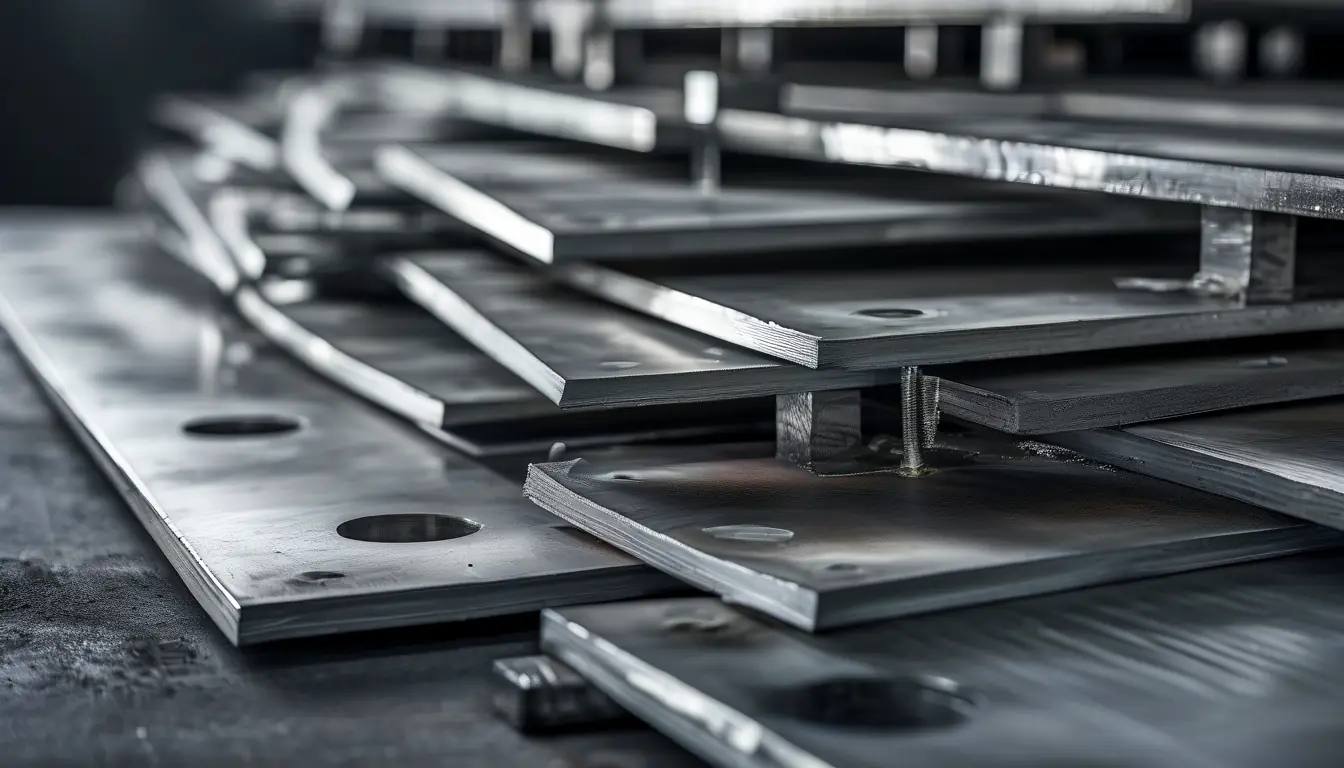
China supplies prefab steel components worldwide, but the gap between a good supplier and a bad one is certification and packing discipline. The checklist we tell buyers to use:
- Material certificates. Every heat of steel should trace to a mill test certificate (EN 10204 type 3.1 style) naming chemistry and mechanicals. For structural components, no certificate = no acceptance on most EN 1090 and AWS projects.
- Execution capability evidence. Ask for the supplier’s experience with your standard and execution class, plus photos and inspection reports from comparable projects.
- Weld quality regime. Welded components (stiffened base plates, anchor-welded embeds) need qualified procedures and welders — ask for WPS/PQR availability under the governing code.
- Dimensional reports, not just “checked.” For connection plates, request hole-pattern inspection reports (coordinate table or CMM printout) on a sampling basis per batch.
- Packing by erection sequence. Components should ship banded by zone/level with a packing list matching your erection plan. Loose containers of unmarked plates cost weeks of sorting on site.
- Surface treatment. Blast + primer (or full paint system) before shipping unless parts are galvanized or will be site-treated; rust in transit is a real rejection cause.
Zemlaser produces the plate-work package for prefab projects — gussets, connection plates, embed plates, stiffeners, mould plates — cut on high-power fiber lasers with structural tolerances, welded anchors added in-house, and packing keyed to your erection sequence. Send the drawings and your governing standard via our quote page; we reply with a firm quotation and a dimensional-control plan inside 24 hours.
Frequently Asked Questions
Can laser cutting make complete steel structures?
No — and you should distrust anyone who says yes. Laser cuts the plate-work components (gussets, connection plates, embeds); rolled beams and columns come from mills, and assembly happens at a fabrication shop. Laser is the precision half of the plate package.
What tolerance can laser-cut connection plates hold?
±0.5 mm on hole positions is routine for plates up to ~40 mm when holes are drilled or laser-cut with position compensation. Thicker plates and flame-cut-then-drilled routes run looser — state your bolt-up requirement explicitly.
Do you supply material certificates with prefab components?
Yes. Every order ships with mill certificates traceable by heat number, and we organize them by component batch so your QA package maps to the erection sequence.
Is buying prefab plate-work from China compatible with EN 1090 projects?
It works where the project accepts imported components under its execution plan — confirm with your responsible welding coordinator / notified body what conformity evidence is required. Components must arrive with the documentation (MTCs, inspection reports) the standard expects, which we prepare as part of the order.
What is the typical lead time for a prefab plate-work package?
Cutting and welding of a standard package runs 2–4 weeks depending on tonnage and weld content; add sea freight. Send drawings early — plate-work is usually on the critical path for steel erection.
References
- BSI Group. “BS EN 1090-2: Execution of steel structures and aluminium structures — Technical requirements for steel structures.” BSI Knowledge. https://knowledge.bsigroup.com/products/execution-of-steel-structures-and-aluminium-structures-technical-requirements-for-steel-structures-1 (accessed August 9, 2026).
- American Welding Society. “AWS D1.1/D1.1M: Structural Welding Code — Steel.” AWS Codes and Standards. https://www.aws.org/standards-and-publications/codes-and-standards/d1-1/ (accessed August 9, 2026).
- McKinsey & Company. “Making modular construction fit.” McKinsey, Operations Insights. https://www.mckinsey.com/capabilities/operations/our-insights/making-modular-construction-fit (accessed August 9, 2026).
- McKinsey & Company. “Putting the pieces together: Unlocking success in modular construction.” McKinsey, Engineering, Construction and Building Materials. https://www.mckinsey.com/industries/engineering-construction-and-building-materials/our-insights/putting-the-pieces-together-unlocking-success-in-modular-construction (accessed August 9, 2026).
- ISO. “ISO 9013:2017: Thermal cutting — Geometrical product specification and quality tolerances.” International Organization for Standardization, 2017. https://www.iso.org/standard/60321.html (accessed August 9, 2026).
- ISO. “ISO 2768-1:1989: General tolerances — Part 1: Tolerances for linear and angular dimensions without individual tolerance indications.” International Organization for Standardization, 1989. https://www.iso.org/standard/7748.html (accessed August 9, 2026).